
OT Cybersecurity: The Complete Guide to IEC 62443 & ICS Security
This comprehensive guide to Operational Technology Cybersecurity (OT Cybersecurity) covers the protection of Industrial Automation and Control Systems (IACS) including DCS, PLC, SCADA, SIS and similar from cyber attacks. Also get more information about standards such as IEC 62443 and NIST 800-82 Rev 3.
✓ Earn PDH · ✓ Accredited certifications · ✓ 5000+ learners worldwide
Table of Contents
Jump to any section:
What is OT Cybersecurity?
Operational Technology (OT) cybersecurity is the protection of industrial control systems — DCS, PLC, SCADA, and Safety Instrumented Systems — from cyber threats that could disrupt operations, damage equipment, harm workers, or release hazardous materials. Unlike IT cybersecurity, where the priority is data confidentiality, OT cybersecurity prioritizes the safe and continuous operation of physical processes in oil and gas, chemicals, power, water, pharmaceuticals, and manufacturing. This guide covers the IEC 62443 series of standards, the Purdue model, major incidents from Stuxnet to Triton, defense-in-depth strategies, and the international regulatory landscape — with links to detailed courses, workshops, and consulting services for each topic.
OT Cyber Risk Assessment
Evaluate the risks of OT systems being attacked and compromised, which can cause physical incidents such as Fires, Explosions or Toxic releases, as well as loss of data, recipes and proprietary knowledge.
Protection of Industrial Automation, Control and Safety Systems
Protect all kinds of Industrial Automation, Control and Safety systems from cyber attacks including PLC, DCS, SCADA, SIS, BMS and other kinds of systems.
Secure OT devices
Secure OT devices throughout their lifecycle — whether you operate them or build them. Asset owners harden, patch, and decommission; OEMs deliver secure-by-design products that meet IEC 62443-4-1, 4-2, and the EU Cyber Resilience Act (CRA
OT (Operational Technology) cybersecurity is the discipline of protecting cyber-physical systems that monitor and control physical processes in industrial facilities. These are generally referred to as Industrial Automation and Control Systems (IACS for short) and may include Distributed Control Systems (DCS), Programmable Logic Controllers (PLCs), SCADA systems, Safety Instrumented Systems (SIS), Building Management Systems (BMS) as well as other specialized systems such as HIPPS (High Integrity Pressure Protection Systems) and the networks that connect them.
OT systems are fundamentally different from the IT systems found in banks, e-commerce websites, or corporate offices. An IT system stores and processes information. An OT system measures and manipulates the physical world — such as opening valves, starting pumps, regulating reactor temperatures, or dispatching electricity A failure in an IT system loses or exposes data.
A failure in an OT system can, in addition to losing or exposing data also leak toxic gas, ignite a fire, take a power grid offline, contaminate a water supply, or destroy machinery worth tens of millions of dollars.
Until the early 2000s, OT systems were considered immune to cyber attack because they were physically isolated from the internet — what was called the “air gap.” That was a myth. The Stuxnet attack proved that an air gapped OT system could also be vulnerable to an attack.
Today, most modern plants are connected to corporate IT networks for production reporting, to vendor networks for remote support, to cloud services for analytics, and increasingly to the public internet through Industrial Internet of Things (IIoT) devices.
| OT Cybersecurity — At a Glance | |
|---|---|
| Primary methods | Risk assessment, defense in depth, zones & conduits, network segmentation |
| Key standards | IEC 62443, EU Cyber Resilience Act (CRA), NIST 800-82 Rev 3, NERC CIP |
| Lifecycle scope | Design through commissioning, operation, and secure decommissioning |
| Differs from | IT cybersecurity — protects physical processes, not just data |
| Key output | Secured zones, reduced cyber risk, audit-ready compliance evidence |
| Industries | Oil & gas, power, water, chemicals, pharmaceuticals, manufacturing |
| Training | OT Cyber Awareness, Fundamentals, CICP — online & certified |
Why OT Cybersecurity Matters
Major Accident Prevention
A successful cyberattack on industrial control systems can disable safety interlocks, manipulate sensor readings, halt production, damage equipment, or trigger releases of hazardous materials — consequences that go far beyond just data loss
Regulatory Compliance
Meeting standards and regulations such as IEC 62443, EU Cyber Resilience Act CRA), NIS2, NIST 800-82, NERC CIP, and India's CEA Cyber Security Guidelines is increasingly mandatory for asset owners and OT device manufacturers alike.
Lifecycle Risk Management
OT cybersecurity is applied across the full asset lifecycle — from secure-by-design specification and procurement, through commissioning and operation, to patching, vulnerability handling, and secure decommissioning at end of life.
OT versus IT cybersecurity- The Fundamental Difference
A widespread mistake — including among experienced IT security professionals — is to assume that OT systems can be protected the same way office IT systems are. This is not true.
OT systems are not “just computers controlling machines.” They are cyber-physical systems with very different priorities, constraints, and consequences of failure. Understanding the differences is the starting point for everything else in OT cybersecurity.
📱 Tip: rotate your device to see the full comparison table
| Aspect | IT Security | OT Security |
|---|---|---|
| Primary priority | Confidentiality of data | Safety and availability of the process |
| CIA triad order | Confidentiality → Integrity → Availability | Availability → Integrity → Confidentiality (AIC) |
| Equipment lifespan | 3–5 years | 15–30+ years |
| Patching cycle | Within days of release | Months — only during scheduled plant shutdowns; many systems never patched |
| Tolerance for downtime | Reboots and outages are routine | Unplanned downtime can cost millions per hour and create safety hazards |
| Operating systems | Current Windows / Linux | Often legacy Windows (NT, XP, 7), embedded RTOS, proprietary firmware |
| Network protocols | TCP/IP, HTTPS, encrypted standards | Modbus, DNP3, OPC, Profinet, EtherNet/IP — often unencrypted by design |
| Consequence of attack | Data loss, ransom, reputational damage | Plant shutdown, equipment destruction, environmental release, worker injury or death |
| Skilled defenders | Large pool — hundreds of thousands of IT security professionals globally | Small pool — OT cyber specialists number in the low tens of thousands worldwide |
| Threat actors | Criminal groups, hacktivists, fraudsters | Nation-states, criminal ransomware groups, disgruntled insiders, hacktivists |
Here is an ICS Security guide that you can refer to for more information.
What is IEC 62443?
IEC stands for the International Electrotechnical Commission and it has about 94 member countries, of which some are full members and others are associate members. IEC standards committees develop standards for electrical and electronics devices and systems.
IEC 62443 is a set of standards and technical reports for cybersecurity of Industrial Automation and Control Systems, in other words, OT systems. It is not one document, but rather several document sets organized into different categories.
Initially when the standard was being developed there were only four categories and you might still see this diagram that shows them, in many blogs, white papers, LinkedIn articles, online magazines and the such but be aware that this is now obsolete. There are now 6 categories, each has several parts. Some of these are still in draft mode (not published or final) whereas some parts are already in their second editions.
Each document is numbered IEC 62443-x-y where x is the category number and y is the document number within that category. So for example you have IEC 62443-1-1 or IEC 62443-2-4 and so on.
At present Category 5 is reserved and there are no documents in it.
Take a look at the picture that shows the current organization of IEC 62443 in the year 2026.
IEC 62443 old structure (now obsolete)

IEC 62443 new structure in 2026 (current)

Take the Certified Industrial Cybersecurity Professional course today, to learn everything about Industrial/OT cybersecurity and IEC 62443 and also earn the CICP title that you can use. For example, John Smith, CICP. Stand out among your peers.
IEC 62443 Published Parts
| Part | Title | Audience |
|---|---|---|
| IEC 62443-1-1 | Terminology, concepts and models — foundational zones, conduits, security levels | All |
| IEC 62443-1-5 | Security Profiles — published, defines the framework for application-specific profiles | All |
| IEC 62443-1-6 | IIoT cybersecurity requirements, published (was previously numbered 4-3) | All |
| IEC 62443-2-1 | Establishing an IACS security program — Cyber Security Management System (CSMS) | Asset owner |
| IEC 62443-2-2 | IACS security protection scheme — Publicly Available Specification | Asset owner |
| IEC 62443-2-3 | Patch management in the IACS environment | Asset owner |
| IEC 62443-2-4 | Security program requirements for IACS service providers | Integrator |
| IEC 62443-3-2 | Security risk assessment for system designs | Asset owner |
| IEC 62443-3-3 | System security requirements and security levels | Asset owner / Integrator |
| IEC 62443-4-1 | Secure product development lifecycle requirements for vendors | Product supplier |
| IEC 62443-4-2 | Technical security requirements for IACS components | Product supplier |
| IEC 62443-6-1 | Evaluation guide for third-party assessors checking compliance to IEC 62443-2-4 | Third-party assessors |
| IEC 62443-6-2 | Evaluation guide for third-party assessors checking compliance to IEC 62443-4-1 | Third-party assessors |
Major OT Cybersecurity Incidents in the past
There have been several OT cybersecurity incidents in the past and this number is growing, not reducing over the past few years. Many incidents are not publicized much. Some of the really infmaous ones are described below in brief. Note that sometimes the OT system is directly attacked and in other cases an attack on the IT system affects the OT system too, due to interconnections.
Stuxnet- Centrifuges destroyed
The most infamous Industrial Cybersecurity attack was on a Siemens PCS 7 DCS which was located at the Natanz facility for Uranium enrichment in Iran. Not just the Control System, even the Variable Frequency Drives that controlled the centrifuge motors were affected.
You can learn more about this incident in detail in the CICP course.
Cyber attacks on electrical grids can not just cause it to shut down and disrupt power supply to millions of consumers, it can also damage power equipment such as circuit breakers by rapidly opening and closing them, causing arcing and damage.
Ukraine Electrical Grid Attack
Attackers targeted Ukarine’s electrical grid, several times in the past few years, stopping power to hundreds of thousands of consumers. Two of these attacks are listed here:
- December 2015 — BlackEnergy — Hit three regional electricity distribution companies. Attackers used spear-phishing to gain entry, pivoted to SCADA, and manually opened breakers using stolen credentials. 230,000 customers lost power. The first confirmed cyber attack on an electrical grid to cause customer outages.
- December 2016 — Industroyer / CrashOverride — A more sophisticated attack on Kyiv’s transmission grid. Used purpose-built malware that spoke industrial protocols natively (IEC 60870-5-101, IEC 60870-5-104, IEC 61850, OPC DA) and could trip breakers autonomously.
TRITON
Attackers specifically targeted a Schneider Triconex Safety Instrumented System Logic Solver at a petrochemical plant in Saudi Arabia. The malware was designed to defeat the SIS interlocks — the last automated defense before a catastrophic event. It was noticed by alert operators, who could bring the plant to a safe state by manual operations and by using the uncompromised DCS.
Triton forced a fundamental rethink of SIS cybersecurity industry-wide. Until then it was believed that no attackers would target an extremely specialized type of safety system such as Triconex, which proved wrong.
This forced a rethink in the Functional Safety community and the IEC 61511 and IEC 61508 standards committees. Now Safety Instrumented Systems much also be assessed for protection against cyber attacks.
When you take the Abhisam Course bundle, you learn both Functional Safety as well as Industrial/OT cybersecurity. Both are essential to know to protect modern Industrial Automation, Control and Safety Systems.
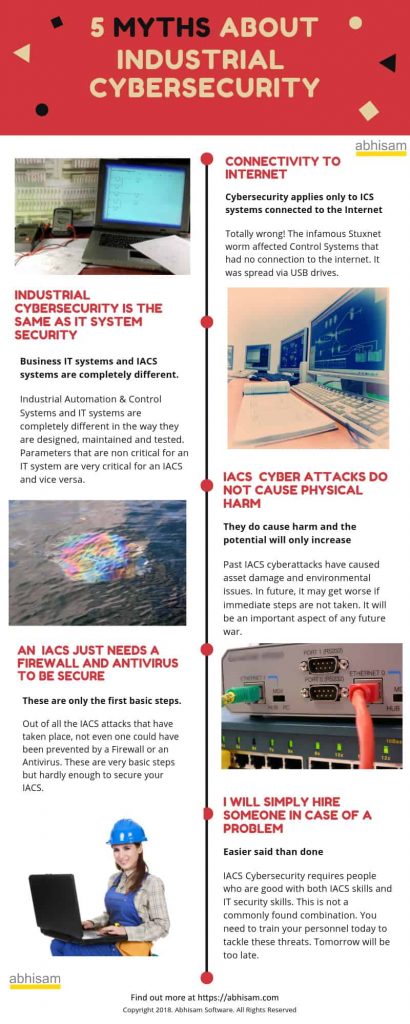
Five Myths About Industrial Cybersecurity — Busted
Dangerous misconceptions about industrial cybersecurity are common even among experienced control system, IT, and management professionals. These myths delay investment, create false confidence, and leave critical industrial systems exposed. The five most common — drawn from Abhisam’s conversations with engineering managers, plant managers, control system engineers, and safety professionals — are summarized below. The full Abhisam whitepaper covers each in more depth with case examples.
Myth 1: My control system is not connected to the internet, so I need not bother about it.
Not true. A control system does not need to be directly connected to the internet to be vulnerable. Stuxnet — the most famous control system malware in history — was spread through USB flash drives, not the internet. The Maroochy Shire wastewater SCADA in Australia was attacked over a wireless link, not the internet. . The air gap, if it ever truly existed, no longer protects you.
Myth 2: Industrial cybersecurity is the same as IT cybersecurity, so it is the IT department’s responsibility.
Business IT systems and Industrial Automation and Control Systems are fundamentally different in how they are designed, maintained, and tested. IT security tools designed for business systems can crash PLCs or trigger unsafe process states. IT security expertise applied to industrial systems without industrial knowledge can cause problems.
Myth 3: Such attacks cannot cause physical harm to plants, people, or the environment.
They can — and they have. The Maroochy Shire attack discharged millions of liters of raw sewage into creeks, parks, and the grounds of a five-star hotel. The Lodtz tram incident derailed two trams. Many other incidents are never reported because organizations do not want to draw attention to lapses, do not want to give ideas to other attackers, or are constrained by legal counsel. The absence of public reporting does not indicate the absence of incidents.
Myth 4: All I need is a firewall and antivirus software.
A firewall at the perimeter of the control system network and antivirus software on Operator and Engineering Stations are necessary but nowhere near sufficient. software updates.
Myth 5: If the problem gets bad, I will simply hire someone to fix it.
Industrial cybersecurity requires people who are competent in both IACS engineering and IT cybersecurity. This is a rare combination — there are very few professionals who know both domains well, and the supply is nowhere near the demand. Building expertise in-house through training is faster, cheaper, and more durable. Start with the Abhisam OT Cybersecurity Awareness course, we provide a free pilot for 5 learners to kick start your organizational training program.
The Abhisam Industrial Cybersecurity Lifecycle — 10 Controls for Robust IACS Security
ndustrial cybersecurity is not a one-time project but a continuous lifecycle. The Abhisam Industrial Cybersecurity Lifecycle model identifies the ten controls that together form a complete cybersecurity program for an Industrial Automation, Control and Safety System (IACS) — covering DCS, PLC, SCADA, SIS, HIPPS, BMS, and the field devices, networks, and human-machine interfaces that make them up.
At the center of the model is the Industrial Cyber Security Management System (ICSMS) — the asset owner’s management framework that oversees and integrates all ten controls.
Note: Currently this ICSMS is known as a Security Program (SP) in the latest (second) edition of IEC 62443-2-1. The first edition had the term CSMS (Cyber Security Management System).
The ICSMS must work in sync with the organization’s main Cyber Security Management System used for IT, while recognizing the operational, safety, and availability constraints that distinguish OT from IT.
The ten controls:
- People, Policies, Procedures and Standards — the foundation. Clear ownership, documented policies, defined procedures, and adoption of recognized standards such as IEC 62443.
- Hazard and Risk Assessment — identifying and ranking cyber risks specific to the IACS, including risks that interact with process safety hazards. Abhisam’s ARSSA tool (Abhisam Rapid Safety and Security Assessment — ready, not yet publicly launched) is built to accelerate this control for teams without dedicated OT security staff.
- Asset Inventory Management — knowing every device, controller, network segment, and software component in the IACS. You cannot protect what you have not inventoried.
- Training and Competency Management — building and maintaining both IACS knowledge and cybersecurity knowledge in the people responsible for the system.
- Secure Architecture, Devices, Configuration, and Software Practices — including secure procurement and supply chain controls. The Havex incident showed that compromised vendor software is a real attack path.

6. Intrusion Detection and Prevention — passive monitoring of industrial network traffic to identify anomalies, supported by appropriate prevention controls at network boundaries. (Intrusion Detection System-IDS)
7. Event Logging and Analysis — capturing system, network, and security events and analyzing them to detect compromise that bypassed prevention layers.
8. Incident Response — a documented, rehearsed plan for what happens when a cyber incident is detected, including the operational decisions specific to a running plant.
9. Backup and Restore — tested, offline backups of PLC logic, HMI configurations, and engineering data. The only reliable defense against ransomware that has reached the OT network.
10. Patch Management and Testing — a disciplined process for evaluating, testing, and deploying vendor patches during planned shutdowns, with compensating controls for systems that cannot be patched.
The ten controls are not independent. Weakness in one — for example, an incomplete asset inventory — undermines the others. A mature ICSMS treats them as interconnected and reassesses them periodically as the threat landscape, technology, and plant configuration evolve.
Safety Instrumented Systems (SIS) Cybersecurity
In the process industries such as Oil and Gas, Chemicals, Fossil Fuel based power generation plants and similar bulk processing plants, the Safety Instrumented System is the last preventive barrier between a process upset and a catastrophic incident, such an explosion, fire or toxic release.
SIS design has always addressed random hardware failure and systematic design faults. What it did not historically address is malicious failures, such as deliberate cyber attack — and the Triton incident in 2017 changed the perspective in the Functional Safety community permanently. Here was an incident where one of the world’s best known, reliable and proven Safety Logic Solvers was the target of a cyber attack that almost caused a disaster. Alert operators in the control room prevented it.
IEC 61511, the functional safety standard for the process industries, now explicitly requires a cybersecurity risk assessment of the SIS (Clause 8.2.4, 2016 edition). This requirement formalizes what Triton made clear: a high SIL rating achieved through rigorous functional safety engineering can be undermined by a cyber attacker if the cybersecurity aspect is ignored.
The Abhisam Functional Safety, SIL and SIS Cybersecurity (Level 1) course covers the basic aspects of cybersecurity of Safety Instrumented Systems.
Functional Safety and OT Cybersecurity
Functional Safety refers to active systems that are used to achieve safety. So far example, an Emergency Stop pushbutton that activates a logic sequence that commands an actuator to shut down a machine, is an example of Functional Safety.
On the other hand, a purely mechanical device, such as a Rupture disk (also known as a burst disk) that is used to relieve excess pressure in a pressure vessel, is NOT functional safety.
Functional Safety professionals design, install, build, commission, operate and maintain Safety Instrumented Systems that conform to standards such as IEC 61508 and the sector specific standard for that industry. For example, in the process industry, the Safety Instrumented System is designed according to IEC 61511 (process industry implementation of IEC 61508).
Find out what is a Safety Instrumented Function (SIF) or a Safety Instrumented System (SIS) here.
In earlier years, SIFs were designed on the basis of PFDavg and Systematic Capability (SC). However this did not take into account malicious failures that could happen due to a cyber attack on the SIS. So the latest edition of the standard IEC 61511 now includes cybersecurity clauses too.
Bad cybersecurity does not merely threaten the SIS from outside. It can corrupt the integrity of the system from within — through unauthorized configuration changes, falsified sensor data, or disabled alarm functions. The degradation of functional safety through cyber compromise is covered in detail in the Abhisam Functional Safety and Cybersecurity White paper


Industrial / OT Cybersecurity and Process Safety
Modern process facilities rely almost entirely on digital control systems — PLCs, DCS, SCADA, and Safety Instrumented Systems (SIS). These systems monitor and control process conditions continuously, trigger alarms when parameters deviate, and activate safety shutdowns when required. Process safety assumes these systems will behave as designed. Industrial cybersecurity addresses what happens when they do not — not due to hardware or software failure, but due to deliberate attack.
A successful cyberattack on an industrial control system can disable safety interlocks, manipulate sensor readings to mask dangerous conditions, prevent alarms from triggering, or force process equipment into unsafe states. The 2010 Stuxnet attack demonstrated that industrial control systems are viable targets. The Triton/TRISIS malware attack (2017) specifically targeted Safety Instrumented Systems in a petrochemical facility — the first known malware designed to disable safety systems and allow physical damage to occur. These are no longer theoretical scenarios.

The connection between process safety and cybersecurity is formally recognized in industry guidance and is increasingly reflected in regulatory expectations. CHAZOP — Computer or Control HAZOP is an example. It extends the standard HAZOP methodology to evaluate how failures or manipulation of digital control systems could create process hazards. It examines control system deviations in the same systematic way that HAZOP examines process deviations, asking what happens if an operator station display becomes blank or unresponsive, or a sensor gives a wrong measurement- whether due to a random failure, or a deliberate attack. A cyber risk assessment should also investigate if any of the recommended HAZOP safeguards could be defeated by a cyber attack.
Thus cyber attacks can also adversely affect Process Safety. Abhisam has courses on both. Abhisam’s RapidHAZOP Tool also includes Cyber factors.
OT Monitoring and Visibility
You cannot respond to what you cannot see. OT environments have historically operated without the monitoring and logging capabilities that IT security takes for granted — and attackers have exploited this blind spot.
OT network monitoring differs fundamentally from IT SIEM: it must be OT friendly (agressive scanning may crash PLCs and RTUs, especially the older ones), it must understand industrial protocols (Modbus, DNP3, OPC-UA, EtherNet/IP) to detect anomalies in control traffic, and it must correlate network events with process behavior.
An OT Security Operations Center (OT SOC) extends monitoring into a staffed function capable of interpreting alerts in process context, escalating to operations when a cyber event has safety implications, and coordinating incident response across OT and IT teams.
Abhisam’s Consulting practice can help you do this reliably.

OT Cybersecurity Training and Certification
Build expertise in OT cybersecurity through our comprehensive training programs designed for IT cybersecurity professionals, as well as Industrial Automation & Control Systems engineers, and facility leaders.
OT Cybersecurity Awareness

- This OT awareness training course helps you get started in OT cybersecurity. This is used by organizations who wish to train hundreds or even thousands of their staff in OT cybersecurity rapidly. You can either deploy this via our LMS and get complete training records management and visibility into learner activity and progress, our host this course on your own internal LMS.
OT Cybersecurity Fundamentals
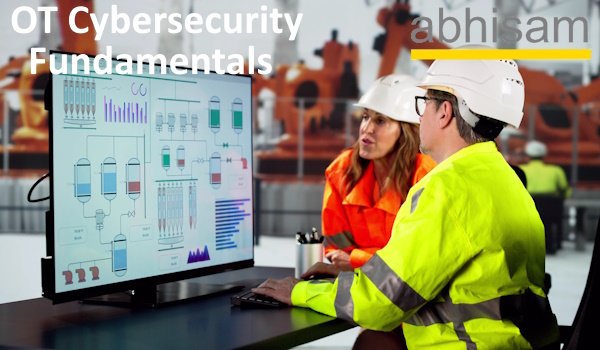
- This OT cybersecurity course goes beyond just awareness into the fundamentals of OT cybersecurity. This is used by organizations who wish to train a large number of employees at a rapid deployment speed. You can use either our LMS that comes with complete training recorrds manageent and learner activity visibility, our use your own LMS. Ideal for demonstrating compliace to IEC 62443 clauses on training.
Certified Industrial Cybersecurity Professional (CICP)

- This is the most popular course in our catalog and has been taken by hundres of professionals all over the world. This course covers everything that you need to know about Industrial /OT cybersecurity. Completing all the modules and passing the exam earns you the title of CICP which you can use.
Lead OT Cybersecurity Auditor program
- The Lead OT cybersecurity auditor program is an Instructor led workshop that is for professionals wishing to be OT cybersecurity auditors. Covers audits based on different IEC 62443 parts.
Industrial/OT Cybersecurity Resources
Technical Resources
Free Guide to OT cybersecurity and IEC 62443
A quick guide to understand the basics of OT cybersecurity and IEC 62443
What is CHAZOP?
Learn what is CHAZOP (Computer HAZOP / Control HAZOP)
What is ICS Supply Chain Cybersecurity
An easy read to understand ICS Supply Chain Cybersecurity.
Articles & Insights
What is IEC 62443-2-4?
Understand IEC 62443-2-4
Cyber Security in Oil & Gas
The article gives you the basics and background of cyber security in the Oil and Gas domain.
What is IEC 62443-2-2?
Understand the basics of the IEC 62443-2-2 standard
What is OT Cybersecurity Risk Assessment
OT cybersecurity risk assessment is different from the usual IT cybersecurity risk assessment. Find out how.
What are IEC 62443 Foundational Requirements?
Understand the seven Foundational Requirements of IEC 62443
Why Industrial Cybersecurity / OT Cybersecurity Cannot Be Learned in Isolation
An OT cybersecurity practitioner working in the process industries today operates at the intersection of three disciplines that were once treated as entirely separate — and that separation is increasingly recognized as a source of risk in itself. These three are:
1. Process Safety
2. Functional Safety and
3. OT Cybersecurity
OT cybersecurity protects the industrial control systems, safety systems, and connected instrumentation/automation and control systems (DCS/PLC/SCADA/BMS/Compressor Controls/Turbine Controls/others) that keep a plant and associated utilities running safely. Functional safety designs the Safety Instrumented Systems whose failure has direct physical consequences, and depends on those systems remaining reliable. Process safety identifies the hazards and suggests various ways of mitigating them by by use of a Safety Instrumented System, or by Basic Process Control Systems (or by other non programmable electronic equipment, or by changes in the process itself or operating procedures).

These three disciplines feed directly into each other. IEC 62443 defines how control and safety systems are protected against cyber threats. IEC 61511 defines what those safety systems must do and to what Safety Integrity Level. The HAZOP and LOPA studies performed under process safety define why those SIL requirements exist and what physical consequences follow if they are compromised. Pull any one thread and the others unravel.
An OT cybersecurity professional who does not understand what a SIF actually does, how a SIL is derived, or why a specific loop was assigned SIL 2 rather than SIL 1 cannot make sound judgments about how to protect it.
Nor can they credibly engage with the process safety engineers and functional safety specialists whose work depends on the cybersecurity being right. Yet most cybersecurity training is written for IT security professionals moving into OT — with detailed treatment of network architecture, protocols, and threat actors, but only surface-level treatment of the safety context in which those systems operate.
The consequence is a widening gap between OT cybersecurity practitioners who understand the plant they are protecting and those who understand only the systems. Attackers do not respect this gap. Triton, Ukraine grid, and the growing body of incidents where cyber compromise led directly to safety consequences all illustrate the same lesson — cybersecurity of industrial systems cannot be evaluated without understanding what those systems are for.
Most training providers reflect the same silo. Cybersecurity providers teach IEC 62443 and network defense. Functional safety providers teach IEC 61511 and SIL calculations. Process safety providers teach HAZOP and LOPA. An engineer who takes an OT cybersecurity course from one provider, a functional safety course from another, and a process safety course from a third rarely comes away with a coherent picture of how the disciplines connect in practice — because no single provider showed them the whole picture.
Abhisam is one of the few training providers that treats these disciplines as one integrated body of knowledge. The same organization that trains you in IEC 62443 and industrial cybersecurity also trains your colleagues in Safety Instrumented Systems, HAZOP methodology, LOPA, Hazardous Area Classification, and Intrinsic Safety. The terminology, the examples, the case studies, and the underlying philosophy are consistent across every course — because they reflect how these disciplines actually work together on a real plant.
If you are building expertise in OT cybersecurity for the process industries, the logical next step is not to search for the best standalone IEC 62443 course. It is to build a structured learning path that covers the full picture — from cybersecurity architecture and IEC 62443 through Safety Instrumented Systems, functional safety, hazard identification, and risk assessment. The engineers who develop this integrated view become disproportionately valuable to their organizations. Abhisam provides all of it.
Abhisam provides Course bundles for exactly this reason. Or simply become a GOLD member and access all of it. If you are an Enterprise, then you can opt for our PLATINUM plans that include all courses.
Process Safety
Prevention of major unwanted events such as Fires, Explosions, loss of containment, gas leaks
OT Cybersecurity
Protection of Industrial Automation and Control Systems (IACS) from cyberattacks, IEC 62443
Hazardous Areas
Explosion protection for vapors and dusts, hazardous area classification
Frequently Asked Questions
IT cybersecurity protects data — confidentiality first, then integrity, then availability. OT cybersecurity protects physical processes — availability and safety first, then integrity, then confidentiality. The priorities are inverted as compared to IT cybersecurity. IT systems can be patched within days; OT systems may not be patched for years together. IT incidents may lose data or expose/exfiltrate data to adversaries; OT incidents can also do the same and in addition also can release toxic gas, take a grid offline, or destroy machinery and may cause injuries to people and damage to the environment. The skill sets, tools, and standards differ accordingly. IT security expertise does not automatically translate to OT cybersecurity competence
IEC 62443 is not one document but rather a series of documents that also include technical reports. Not all parts have been published and some parts have seen their second editions already published. So the progress is uneven. Recently the structure of the series also changed.
IEC 62443 is a voluntary international standard, but it is increasingly referenced by binding national regulations and sectoral mandates. The EU NIS2 Directive references it as the technical baseline for industrial control system security. National regulators in Saudi Arabia (NCA OTCC), Singapore (CCoP), and elsewhere require compliance with IEC 62443 or compatible standards. In the US, TSA Security Directives for the pipeline and rail sectors require controls that align with IEC 62443 and NIST 800-82. In practice, IEC 62443 is the standard that asset owners are expected to follow.
There is no “official” IEC 62443 training. There are several training providers including Abhisam, who have training courses for IEC 62443.
Most Abhisam OT cybersecurity /Industrial cybersecurity courses can be taken by anyone with a technical background who has some knowledge of computers, networking and has worked in an industrial environment.
The Purdue Enterprise Reference Architecture was first published in the 1990s and reflects the hierarchy of Control Systems and Enterprise systems of those times. It organizes industrial computing systems into six levels, from physical sensors at Level 0 to enterprise business systems at Level 5. It remains the dominant mental model in OT cybersecurity and the basis for the zones-and-conduits approach in IEC 62443. Modern architectures that utilize smart sensors which may also have internet connectivity such as IIoT devices with, cloud connectivity, and edge computing have blurred the boundaries between Purdue levels. But it is a useful reference even today.
A true air gap — physical isolation of OT networks from all other networks — is rare in practice and difficult to maintain. Most plants described as air-gapped turn out to have at least one of: corporate IT data flows for production reporting, vendor remote support paths, USB-based engineering backups, or IIoT devices with their own connectivity.
Yes — and the recent record of attacks on water utilities in the US (Oldsmar, Aliquippa and more recently the California Water Service) and on smaller manufacturers, makes the case clearly. Small operators are often more vulnerable, not less, because they have fewer dedicated cyber staff and more legacy systems. Attackers do not always target the largest organizations; they target the most vulnerable ones.