
Process Safety Training & Certification
Process safety training for engineers, managers, and safety professionals — trusted by Fortune 500 companies.
✓ Earn PDH · ✓ Accredited certifications · ✓ 5000+ learners worldwide
Table of Contents
Jump to any section:
What Is Process Safety?
Process safety is the discipline of preventing major industrial accidents — fires, explosions, and toxic releases — in facilities that handle hazardous materials. It applies to oil and gas, chemicals, pharmaceuticals, power generation, and any process industry where the consequences of equipment failure or human error could affect workers, the public, and the environment simultaneously. Process safety relies on structured hazard analysis methods — principally HAZOP, LOPA, and What-If Analysis — applied across the full facility lifecycle from design through operation to decommissioning. Key standards include OSHA PSM (USA), COMAH (UK), and the Seveso III Directive (EU).
Risk Assessment & Mitigation
Evaluate the risks of Dangerous incidents using PHA techniques such as HAZOP, LOPA and What-If Analysis (SWIFT)
Fire & Explosion Prevention
Prevent Fires and Explosions from occurring, even while processing highly flammable and explosive materials
Toxic Release Prevention
Preventing toxic chemical releases that could harm workers and communities.
Safe Chemical Storage
It is important to store chemicals in warehouses which are especially designed for safe storage of hazardous / toxic chemicals.
Industries that handle bulk materials are referred to as Process Industries. Examples are Oil & Gas refining, Chemicals manufacturing, bulk Pharmaceuticals manufacturing, Food and Beverage manufacturing and similar. Very often, due to the huge quantities of materials processed at high temperatures and pressures, any accident can cause severe consequences, such as Fires, Explosions and Toxic releases that can also affect the general public, not just the workers in these industries. Hence, Process Safety is vitally important to keep these facilities safe and prevent unwanted incidents and accidents.
It should be noted that Process safety is fundamentally different from Occupational safety. While Occupational safety focuses on protecting individual workers from workplace injuries, process safety addresses the prevention of catastrophic incidents that could affect multiple people, the environment, and assets simultaneously.
At the heart of process safety lies Process Hazard Analysis (PHA) – a systematic approach to identifying, evaluating, and controlling hazards associated with process operations. PHA includes risk assessment and mitigation methods such as HAZOP, LOPA, What-If Analysis (SWIFT) and others that can help organizations understand potential failure scenarios and implement appropriate safeguards before incidents occur.
Understanding the mechanism of fires and explosions is important to prevent them from occurring. Abhisam has several courses related to Process Safety that help professionals master the subject and get certified.
Process Safety — At a Glance
| Primary methods | HAZOP, LOPA, What-If Analysis (SWIFT) |
| Key standards | OSHA PSM, EPA RMP, COMAH, Seveso III |
| Lifecycle scope | Design through decommissioning |
| Differs from | Occupational safety — systemic vs individual hazards |
| Key output | Risk reduction and safeguard documentation |
| Industries | Oil & gas, chemicals, pharma, power, food & beverage |
| Training | HAZOP, LOPA, What-If Analysis — online & certified |
Why Process Safety Matters
Major Accident Prevention
Systematic identification and control of hazards prevents catastrophic incidents that could result in multiple fatalities, environmental damage, and significant asset loss.
Regulatory Compliance
Meeting international standards and regulatory requirements such as OSHA PSM, EPA RMP, and Seveso Directive ensures legal compliance and demonstrates due diligence.
Lifecycle Risk Management
Process safety is applied throughout the facility lifecycle – from design and construction through operation, modification, and decommissioning.
What is Process Hazard Analysis (PHA)?
Process Hazard Analysis (PHA) refers to a structured way of identifying hazards in a process, assessing the risk due to them and evaluating ways to prevent unwanted incidents occurring due to them. PHA is not one single technique but rather set of different techniques such as HAZOP, LOPA, What-If (SWIFT) and others. Carrying out a PHA is one of the first steps to ensuring process safety. Abhisam has several PHA related courses such as those on HAZOP, LOPA and What-If analysis.
Identify Hazards
Systematic hazard identification
Evaluate Risk
Assess likelihood and consequences
Control Measures
Implement safeguards and protections
Which are the Key PHA Methods?
HAZOP
HAZOP (Hazard and Operability Study) is the most widely used PHA method in the process industries. It employs a systematic approach using guidewords (MORE, LESS, NO, REVERSE, etc.) combined with process parameters (FLOW, TEMPERATURE, PRESSURE) to identify deviations from normal operation.
A multidisciplinary team examines each process node, systematically exploring potential causes and consequences of deviations, and recommending safeguards or action items to reduce risk.


LOPA
Layer of Protection Analysis (LOPA) is a semi-quantitative risk assessment technique that evaluates independent protection layers (IPLs) for specific hazard scenarios. It bridges the gap between qualitative methods like HAZOP and fully quantitative risk assessments.
LOPA assigns numerical values to initiating event frequencies and IPL failure probabilities to calculate residual risk and determine if additional safeguards are needed, often leading to Safety Instrumented System (SIS) requirements.
What-If Analysis (SWIFT)
What-If Analysis (also called SWIFT which stands for Structured What-If Analysis) is a flexible, brainstorming-based PHA method where team members pose questions beginning with “What if…” to identify potential hazards. It’s particularly effective in early design phases or for less complex processes.
The method encourages creative thinking and can be combined with checklists to ensure comprehensive coverage. While it is considered less comprehensive than HAZOP, it’s faster and can effectively identify major hazards when facilitated by experienced personnel.

How to prevent Fires and Explosions in industry?
Understanding Fires and Explosions
In many industries such as chemicals, petrochemicals, oil and gas, mining & metals, pulp and paper, power generation, nuclear processing and many others, there is a risk of fire or an explosion happening. Understanding how fires and explosions occur is the first step towards preventing their occurrence and minimizing the risks that they pose to assets, people and the environment.
It takes a lot of money to design, install, commission and run an industrial facility. All of this may vanish if the designers and operators are not aware of the risks posed by fire and explosion. This will not only cause asset loss, but also harm to people and the environment and result in legal actions by authorities. Insurance companies may refuse to cover the loss, if the design is proved to be faulty.


Preventing Fires and Explosions
Once a fire starts or an explosion happens, there is not much that can be done. At best, the ensuing damage can only be contained (to some extent). Plants and facilities are not cheap, replacing them can be very very expensive.
Also the losses due to such accidents very often exceed the original cost of the investment.
Let that sink in. Yes, the loss due to fire or explosion in industry, can many times exceed the original cost of the asset and can threaten the existence of the company itself. This is unlike other assets where damage to the asset can be usually a percentage (less than 100%) of the original cost.
What is Safe Chemical Warehousing?
How to store and handle chemicals safely in warehouses?
Many of the chemicals used in industry are hazardous. They may be toxic, inflammable, reactive or all of these. Hence it is important to know the techniques of safe storage of these chemicals, in order to prevent disasters.
One of the most infamous chemical warehouse disaster took place in Tianjin, China where improper storage of chemicals in a warehouse led to huge explosions and fires and resultant asset damage, loss of life (hundreds dead), injuries (severe injuries to hundreds of people) and severe environmental impact. The explosion could reportedly be seen even from space!

Key Process Safety Standards and Regulations
Which are some key Process Safety related standards and regulations?
Every country and legal jurisdiction have laws, rules and regulations to ensure process safety in industries that process hazardous materials. Additionally there are several international standards.
For example, all hazardous chemicals processing industries in the US follow OSHA PSM (29 CFR 1910.119), which contains requirements for the management of hazards associated with processes using highly hazardous chemicals. Similarly the UK has COMAH which is short for Control of Major Accident Hazards Regulations 2015. These are applicable to industries that handle hazardous materials meeting certain threshold requirements.
In the European Union, there are directives such as the Seveso III directives that applies to sites with dangerous substances (e.g., chemical, petrochemical, manufacturing).
Certifications and Career Impact | Learning Paths
Which courses should I take to enhance my career prospects?
Every country and legal jurisdiction’s rules and regulations have provisions for
a) requiring training for professionals working in process safety related domains and
b) mandating that only competent professionals, with adequate knowledge and skills are allowed to work in process safety related jobs.
Both of these conditions are satisfied when you take Abhisam’s Process Safety related courses. Also since Abhisam’s courses are globally recognized, most learners can expect to progress faster in their careers when they take Abhisam’s courses and earn certifications.

Learning Paths for Process Safety Professionals
Most of Abhisam’s Process Safety related courses can be taken by any technical professional, who is working in the process industry or other technical fields allied with the Process Industry (such as Engineering Consulting firms, EPC companies, Contractors, Government Regulatory bodies or independent Safety Consultants & Practitioners).
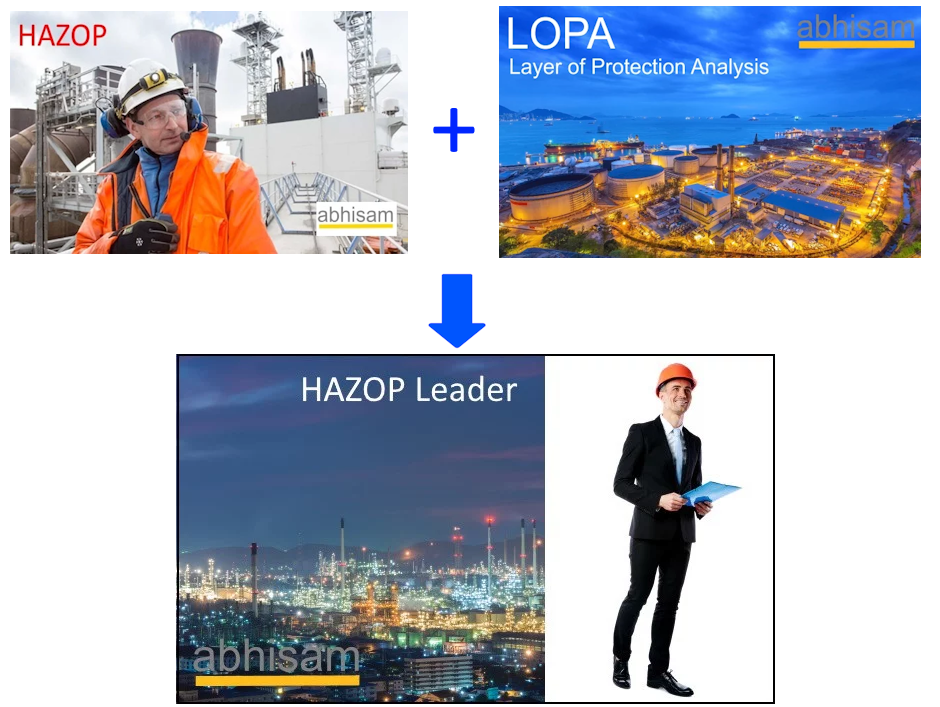
Some courses like the Certified HAZOP Leader can be taken only if you have the necessary qualifications or have taken the HAZOP Professional course earlier. If you have any questions about eligibility, please get in touch with us anytime. The picture shows a popular learning path.
Process Safety and Functional Safety
The relationship between process safety methods forms a critical pathway from hazard identification to safety system implementation. HAZOP identifies scenarios, LOPA quantifies risk, and SIL determination specifies required safety system reliability.

Process Safety and Occupational Safety
Process safety and Occupational safety are both essential disciplines in any industrial facility — but they address fundamentally different types of risk and require different tools, standards, and expertise.
Occupational safety focuses on protecting personnel at the individual level from direct everyday workplace hazards — slips, falls, head injuries, manual handling injuries, exposure to noise, and similar incidents that affect one person at a time. It is governed by standards such as OSHA General Industry regulations in the US, local workplace health and safety legislation at the state or municipal level, and good practice frameworks such as ISO 45001. There are different Occupational Health and Safety standards in different jurisdictions around the world and they must be followed if you do not want to break the law.

Process safety addresses a different type of risk which is at the macro level. A process safety incident — a fire, explosion, or toxic release — can affect dozens or hundreds of people simultaneously, including workers, contractors, and even people staying outside the perimeter such as nearby communities. It can destroy assets worth hundreds of millions, trigger regulatory shutdown, and result in criminal liability for management. The tools of process safety — HAZOP, LOPA, What-If Analysis — are designed specifically to identify and control these low-probability, high-consequence scenarios before they occur. The two disciplines complement each other: a facility that manages occupational safety well but neglects process safety is not truly safe. Both are required. This was brought out clearly in the Baker Committee report that was constituted to investigate the root cause of the BP Texas City accident.
Abhisam offers training in both disciplines. Process safety courses cover HAZOP, LOPA, What-If Analysis as well as courses such as Understanding Fires and Explosions, Preventing Fires and Explosions. Occupational safety courses cover Industrial Hygiene, Industrial Toxicology, Confined Space Safety, PPE, and LOTO.
Process Safety and Industrial / OT Cybersecurity
Modern process facilities rely almost entirely on digital control systems — PLCs, DCS, SCADA, and Safety Instrumented Systems (SIS). These systems monitor and control process conditions continuously, trigger alarms when parameters deviate, and activate safety shutdowns when required. Process safety assumes these systems will behave as designed. Industrial cybersecurity addresses what happens when they do not — not due to hardware or software failure, but due to deliberate attack.
A successful cyberattack on an industrial control system can disable safety interlocks, manipulate sensor readings to mask dangerous conditions, prevent alarms from triggering, or force process equipment into unsafe states. The 2010 Stuxnet attack demonstrated that industrial control systems are viable targets. The Triton/TRISIS malware attack (2017) specifically targeted Safety Instrumented Systems in a petrochemical facility — the first known malware designed to disable safety systems and allow physical damage to occur. These are no longer theoretical scenarios.

The connection between process safety and cybersecurity is formally recognized in industry guidance and is increasingly reflected in regulatory expectations. CHAZOP — Computer or Control HAZOP is an example. It extends the standard HAZOP methodology to evaluate how failures or manipulation of digital control systems could create process hazards. It examines control system deviations in the same systematic way that HAZOP examines process deviations, asking what happens if an operator station display becomes blank or unresponsive, or a sensor gives a wrong measurement- whether due to a random failure, or a deliberate attack. A cyber risk assessment should also investigate if any of the recommended HAZOP safeguards could be defeated by a cyber attack.
Thus cyber attacks can also adversely affect Process Safety. Abhisam has courses on both. Abhisam’s RapidHAZOP Tool also includes Cyber factors.
Process Safety Training and Certification
HAZOP (Standard or Professional)
- Master the HAZOP methodology — guidewords, process parameters, node examination, cause-consequence analysis, and safeguard documentation
- Self paced, 16 hours
- Certificate included, Digital Badge for Professional version
HAZOP Leader
- For qualified HAZOP Professionals — advanced facilitation skills to independently chair and lead HAZOP studies
- Self-paced, 40 hours
- Certificate and Digital badge included
- Free RapidHAZOP Software license (1st year)
LOPA (Standard or Professional)
- Layer of Protection Analysis from first principles — IPL selection, frequency calculations, risk tolerability criteria, and SIS requirements
- Self-paced, 60 hours
- Certificate included, Professional version gets Digital badge
What-If Analysis
- Structured What-If Analysis methodology — guideword-based brainstorming, checklist integration, and documentation
- Self paced, 8 hours
- Certificate included
Process Safety Resources
Technical Resources
HAZOP Study Guide
Comprehensive guide to conducting effective HAZOP studies
What is CHAZOP?
Learn what is CHAZOP (Computer HAZOP / Control HAZOP)
How to do a What-If Analysis?
How To Conduct A What-If Analysis for Process Safety Risk Assessment
How to store chemicals in warehouses safely?
How to design and operate a chemical warehouse safely
Articles & Insights
How Process Safety Management reduces Enterprise Risk
Good Process Safety Management can dramatically reduce overall Enterprise risk
HAZOP- the 3 things that you must consider
Carrying out a HAZOP? Here are three things to consider
What is LOPA?
Here are the basics of Layer of Protection Analysis
Why Process Safety Cannot Be Learned in Isolation
An engineer working in the process industries today operates at the intersection of three disciplines that were once treated as entirely separate — and that separation is increasingly recognised as a source of risk in itself.
Process safety identifies what can go wrong and quantifies the risk. Functional safety designs and verifies the Safety Instrumented Systems that prevent it. Industrial cybersecurity ensures those safety systems cannot be compromised, bypassed, or manipulated by malicious actors. These three disciplines feed directly into each other. A HAZOP study generates the hazard scenarios that LOPA evaluates. LOPA determines the Safety Integrity Level that IEC 61511 requires the SIS to achieve. IEC 62443 ensures the control and safety systems implementing those requirements are protected against cyber threats. Pull any one thread and the others unravel.

Most training providers cover one of these disciplines in depth and treat the others as adjacent topics or ignore them entirely. An engineer who takes a HAZOP course from one provider, a functional safety course from another, and a cybersecurity course from a third rarely comes away with a coherent picture of how the disciplines connect in practice — because no single provider showed them the whole picture.
The same organization that trains you in HAZOP methodology also trains your colleagues in Safety Instrumented Systems, Intrinsic Safety, Hazardous Area Classification, and OT Cybersecurity. The terminology, the examples, the case studies, and the underlying philosophy are consistent across every course — because they reflect how these disciplines actually work together on a real plant,
If you are building expertise in process safety, the logical next step is not to search for the best standalone HAZOP course. It is to build a structured learning path that covers the full picture — from hazard identification through risk quantification, safety system design, equipment certification, and cybersecurity. Abhisam provides all of it.
Process Safety
Prevention of major unwanted events such as Fires, Explosions, loss of containment, gas leaks
OT Cybersecurity
Protection of Industrial Automation and Control Systems (IACS) from cyberattacks, IEC 62443
Hazardous Areas
Explosion protection for vapors and dusts, hazardous area classification
Frequently Asked Questions
HAZOP is a qualitative hazard identification method that systematically examines process deviations using guidewords. LOPA is a semi-quantitative method that evaluates specific scenarios identified in HAZOP (or other PHAs) by assigning numerical values to initiating event frequencies and protection layer effectiveness. HAZOP asks “what can go wrong?” while LOPA asks “is the risk tolerable and are safeguards adequate?”
Process safety addresses the prevention of catastrophic incidents — fires, explosions, toxic releases — that can affect multiple people, communities, and the environment simultaneously. Occupational safety focuses on protecting individual workers from everyday workplace injuries such as slips, falls, and equipment accidents. Both are important but they use different methods and standards. OSHA PSM, COMAH, and Seveso cover process safety; OSHA General Industry standards cover occupational safety.
In the USA, OSHA PSM (29 CFR 1910.119) applies to facilities handling highly hazardous chemicals above threshold quantities. The EPA RMP rule has parallel requirements. In the UK, COMAH 2015 applies. In the EU, the Seveso III Directive governs major hazard sites. Most standards require a documented Process Hazard Analysis using methods such as HAZOP or What-If Analysis.
Most Abhisam process safety courses — including HAZOP Professional, LOPA, and What-If Analysis — are open to any technical professional working in or allied with the process industries. The Certified HAZOP Leader course requires prior completion of the HAZOP Professional course or equivalent experience. No formal academic prerequisites apply to entry-level or professional courses.
Process safety is not a one-time activity but a lifecycle discipline requiring continuous attention, expertise, and commitment. From initial design through operation and eventual decommissioning, systematic hazard analysis and risk management protect people, assets, and the environment. Whether you’re beginning your process safety journey or advancing your expertise, the methods and resources presented here provide a foundation for safer operations.