
Gas Monitors Training Course with free certification
Gas Monitors (also known as Gas detectors) keep workplaces and people safe.
Learn How they work, how to select them and maintain them – so that they continue to enhance safety in your workplace.
If you already know how these devices work, then enhance your knowledge with this unique training. Get Certified for free when you get this XPRTU (software that trains you & makes you an expert) now!
Key Benefits of the Course
- Self Paced Course, learn at your own speed, whenever you wish
- Learn from home, office or anywhere else
- Access from any device PC/laptop/Mac/Tablet-no restrictions
- Includes Online Exam and Certification
- Prove your competency by displaying your electronic badge online on social media
- Full fledged e-learning course- Its not a video of a guy speaking or a pdf or a PPT
- Learn from Real life situations and case studies
Includes a Real Life Case Study- as good as doing it yourself!
Gas Monitors (also known as Gas detectors) keep workplaces and people safe.
Take this Abhisam Gas Monitors training course and learn how they work, how to select them and maintain them – so that they continue to enhance safety in your workplace.
If you already know how these devices work, then enhance your knowledge with this unique training.
Get Certified for free when you get this XPRTU (software that trains you & makes you an expert) now!
You probably already know just how important this Gas Detection training is and how difficult it can be to learn everything that you need to know.
Just as the correct selection and use of gas or vapor detection equipment, can save you and your workplace from disaster, the wrong selection or improper working of such equipment can actually cause a disaster!
A wrongly selected gas detection and measurement instrument will not only fail to work properly, but it will also lull you into a false sense of security.
This is worse than not having a gas monitor at all!
This is not a hypothetical situation.
It happens plenty of times in industrial plants all over the world.
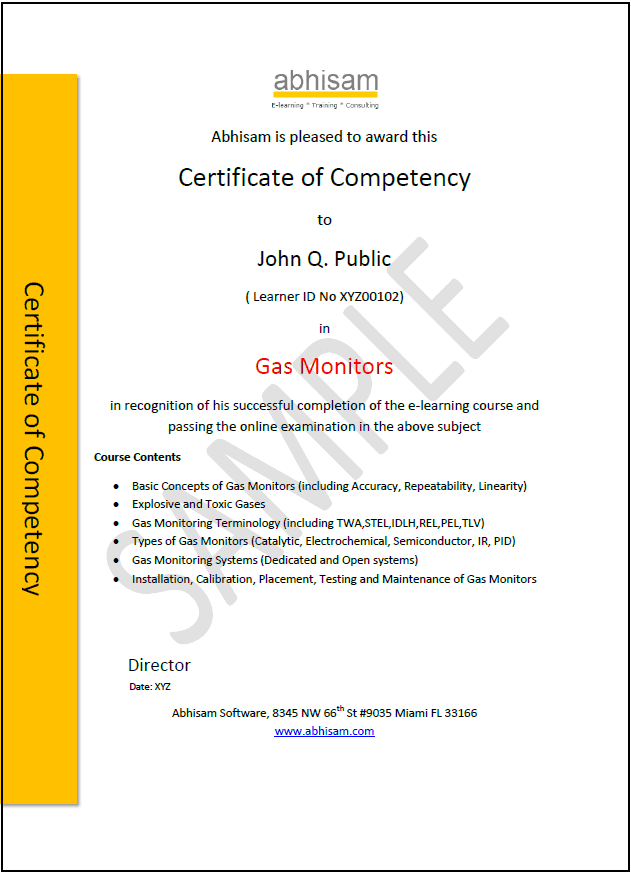
Take this easy to understand Gas Detectors course today and get certified as a Gas Monitors professional, with a Certificate of Competency and an Electronic Badge.
See below what is included in this course.
Get Certified as a Gas Monitors Professional! Earn an electronic badge that you can display online.
This is the best course I have come across in Gas detection systems. I am working in an Oil & Gas processing plant. After completing this course, I have got lot of confidence in the system. The information that we learn can be directly applied in our day to day operations.
The course is well written in a simple language without missing the essential information. The information that we learn in this course cannot be learned even in a regular “fire and gas systems course” which costs multiple times than this. It is very useful for engineers who are working in design and operation & maintenance as well not to exclude sales.
Mr. Natarajan, National Drilling Company-Saudi Arabia

After you complete the course, you can take the built in Self Assessment Test, that will help you gauge your own understanding of the subject. It also helps you as a Mock Exam before you take the FREE online Certification Exam.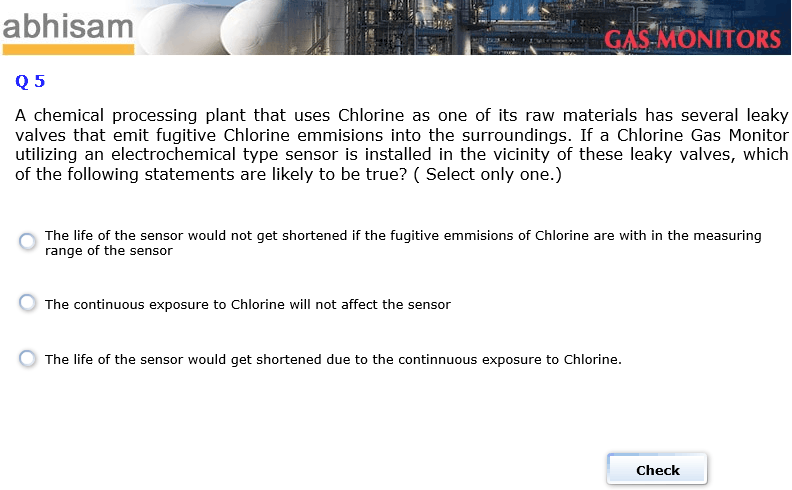
Real Life Examples from industry
When you take this easy Abhisam Gas Monitors course you will be able to
- Understand the meaning of various terms to monitor gases and fugitive emissions
- Select the right kind of gas detectors after understanding the technology used in different types of gas detectors
- Understand how portable and fixed type gas detectors work.
- Understand how gas monitoring systems work
- Learn how to test them, calibrate them and maintain them
Covers all of these popular Gas Monitoring and Gas Detection technologies
Learn all modern technologies used in gas detection including their advantages and drawbacks, select the ones that best suit your requirements of gas detection.
Learn how all of these work
- Catalytic Combustion
- Electrochemical
- Semiconductor
- Infrared (IR)
- Photoionization Detectors (PID)
Choose from any of the versions.
Scroll below to see complete contents.
Standard
For one learner-
Course Duration: 12 hours of self paced learning (Earn 12 PDH)
-
Access the course online 24/7 via any device for one year
-
Exam & Certification for one learner
-
Lifelong Valid Certificate
Professional
For one learner-
Everything in Standard plus
-
Access the course for 3 years
Get Access to all Abhisam Trial courses, including this Gas Monitors course for $7. You will NOT be billed automatically after trial ends.
Note: Trial versions of courses have only the first few modules viewable.
Table of Contents
Lesson One – Introduction to Gas Monitors
What is a Gas Monitor?
Why use a Gas Monitor?
History of Gas Monitors
Where are Gas Monitors used ? – Oil refining
Where are Gas Monitors used ? – Storage Tanks
Where are Gas Monitors used ? – Oil Production
Where are Gas Monitors used ? – Electronics and semiconductor plants
A typical gas monitor
A personal Gas Monitor
A portable Gas Monitor
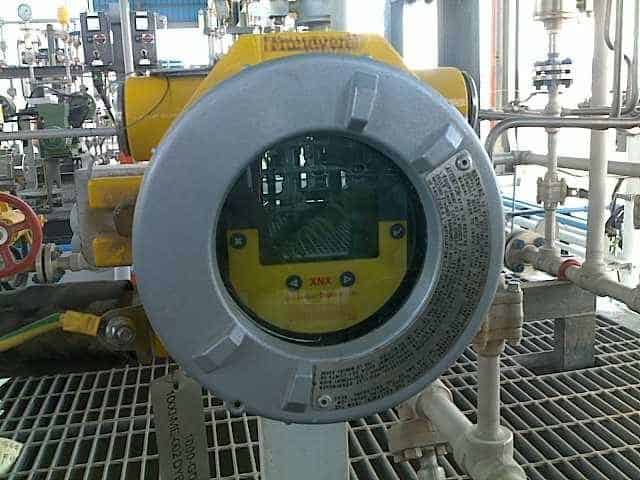
A fixed Gas Monitor
Lesson Two – Basic Concepts
Fire Triangle
Lower Explosive Limit and Upper Explosive Limit
Flash Point
Accuracy
Accuracy and Inaccuracy
Accuracy of a Gas Monitor
ReviewQ1
Calibration
Linearity
Repeatability
Repeatability and Accuracy
An exercise in repeatability
Lesson Three – Explosive and Toxic Gases
Explosive Gases and Toxic Gases
Regulatory & Standards Bodies
Terminology – Explosive Gases
Terminology – Toxic gases
TWA (Time Weighted Average)
More on TWA (Time Weighted Average)
STEL (Short Term Exposure Limit)
IDLH & Ceiling Limit
REL, PEL & TLV – What do they mean ?
REL, PEL & TLV – Some Values
A graph of TWA, STEL and Ceiling Limits
ReviewQ2
Lesson One – Catalytic Combustion Type
Catalytic Combustion sensor – How it works
Catalytic Combustion sensor – Construction
Catalytic Combustion sensor – Characteristics
Catalytic Combustion sensor – Advantages and Disadvantages
Lesson Two – Electrochemical Type
Electrochemical sensors – Principles
Electrochemical sensors-Actual Operation
Electrochemical sensors – Construction
Electrochemical sensors – Other Characteristics
Electrochemical sensors – Interference
Electrochemical sensors – Advantages and Disadvantages
Lesson Three – Semiconductor Type
Semiconductor sensors – Introduction
Semiconductor sensors – Working
Semiconductor sensors – Advantages and Disadvantages
Lesson Four – Infra Red Type
Infra Red sensors – How are they different ?
Waves
Basics of Waves
The Electromagnetic Spectrum
Infra Red sensors – Basic Concepts
Transmittance and Absorbance
Infra Red Sensors – Beer Lambert Law
Infra Red sensors – Absorption Pattern of Methane
Infra Red monitors
Infra Red monitors – Dispersive
Infra Red monitors – Non Dispersive
Open Path IR
Infra Red Gas Monitors – Open Path Concepts
Point Type IR
Infra Red Gas Monitors – Point Type and Open Path
Infra Red Gas Monitors -Advantages and Disadvantages
Lesson Five – PID Type
Photo Ionization Detectors – Introduction
Photo Ionization Detectors – Principle of Operation
Photo Ionization Detectors – A typical instrument
Photo Ionization Detectors – The UV Lamp
Photo Ionization Detectors – Kinds of Lamps
Photo Ionization Detectors – Lamp selection
Photo Ionization Detectors – Correction Factors
Photo Ionization Detectors – VOC Monitoring
Photo Ionization Detectors – Alarm Limits
Photo Ionization Detectors – Advantages and Disadvantages
Modular Gas Detectors
Portable Gas Detectors
Use in Hazardous Areas
Review Q3
Lesson One – Dedicated Systems
Dedicated Systems – Introduction
Dedicated Systems – The channel card
Dedicated Systems – Architecture
Dedicated Systems-Advantages and Disadvantages
Lesson Two – Open Systems
Open Systems – Introduction
Open Systems – Integrated DCS & Gas Monitoring System
Open Systems – Other possibilities
Open Systems – Advantages & Disadvantages
Lesson One – Planning & Installation of Gas Monitors
Planning of Gas Monitoring systems
Planning of Gas Monitoring systems – placement
Relative weights of different gases
Planning of Gas Monitoring systems – placement
Placement of the Gas Monitors
Lesson Two – Calibration and Testing
Calibration of Gas Monitors
Preparation for Calibration
Calibration of Gas Monitors – Example
Calibration of Gas Monitors – Bump Test
LEL values of Explosive Gases
Correction Factors – Catalytic Combustion Monitors
Calibration Factors – PID instruments
Calibration – Tips for a better Gas Monitor performance
Lesson Three – Maintenance
Maintenance of Gas Monitors – Introduction
Maintenance of Gas Monitors – example
Thank You
The Self Assessment Test has several questions that help you prepare for taking the associated exam to earn the Certificate of Competency in Gas Monitors.
Just get this Gas Detection e-learning course today and for a much lesser price that you would be paying for any other course out there!
Just get this Gas Monitors XPRTU today and for a much lesser price that you would otherwise pay for a traditional, classroom training course, learn everything that you wanted to know about this technology. Note that this software includes all the leading Gas Detection technologies like Catalytic Combustion, Infrared, Semiconductor, Electrochemical and Photo Ionization. No other training course anywhere else includes all of these in one package!
Of course, you could always pass this up and decide to go for that seminar or classroom training, whenever that is offered , or buy a book on this topic,
but,
remember that any of the following things can happen…..
a) this low price will not last for long.
b) you will forget all about this, till the time comes for you to choose a Gas Detection technology for your plant or facility and vendors may give conflicting versions of which technology is best suited for your application.
c) You forget about this Abhisam Gas Monitors training XPRTU program completely. Then you enroll yourself in an expensive $ 2000 classroom course, travel halfway around the globe to attend it, (if it is even possible in these COVID-19 times) spend some more of your already depleted training budget on it, spend a week in a different remote city (while work piles up back in office on your desk) and then forget whatever you learned when the time comes to finally apply the concepts learned in your work.
d) You decide to skip this offer and opt to buy a book on this topic. However, there are a couple of problems with this option. The first problem is that a no single book covers all the topics that you need to know. On the other hand, there are a lot of things in every book, that you can safely skip, without missing anything. So you may have to wade through dull books, written a long time ago, to understand a new technology. Not a very appealing prospect.
Plus nobody will give you a certificate for reading a book!
So, why don’t you simply get this first of its kind training software and
a) Be assured that you have the best course in an e-learning format with easy to understand ANIMATIONS & SIMULATIONS that make learning this topic fun and easy! See above for a sample animation.
b) Get a comprehensive program that will remove all the “complexity” that is normally associated with this subject.
c) Join the hundreds of other engineers and technical professionals all over the world, who have experienced this software and benefited greatly from it.
d) Take our online exam and get Certified for FREE (on passing). Yes, there’s no extra charge for this. PLUS very soon, get yourself an electronic badge too, that you can display on your LinkedIn or Facebook profile! This shows the world (including potential recruiters, potential employers and clients) that you are skilled in Gas Monitoring.
What does the $7 trial include?
The $7 trial includes trial access to ALL the courses in the Abhisam Catalog for a limited time.
After the trial is over you can choose to either buy an individual course OR subscribe to the GOLD or PLATINUM membership plans.
Your card will not be billed automatically.
Which versions are available?
This course is available as either stand alone (select the Standard version above), Professional, or as part of the Abhisam GOLD membership level.
The Standard version allows you to access the course online from any device (PC/tablet/smartphone) that has an internet connection and a browser that supports HTML 5 (such as Mozilla Firefox, Google Chrome, Internet Explorer, Microsoft Edge, Opera, etc). You can access the course for a period of one year, within which you need to take the exam to earn a Certificate (electronic). You will also earn an electronic badge that can be displayed online on LinkedIn and similar portals.
The Professional version allows you to access the course online for 3 years from any device (PC/tablet/smartphone) that has an internet connection and a browser that supports HTML 5 (such as Mozilla Firefox, Google Chrome, Internet Explorer, Microsoft Edge, Opera, etc). You can access the course for a period of three years, within which you need to take the exam to earn a Certificate (electronic). You will also earn an electronic badge that can be displayed online on LinkedIn and similar portals.
The content in the Standard and Professional versions is the same.
What is the Abhisam GOLD membership?
When you subscribe to the Abhisam GOLD membership, you get access to all the courses in the Abhisam Catalog, by paying just one low monthly subscription. You can also get a free certification exam every month. If you are interested in taking a bunch of courses, then the GOLD membership gives you an affordable plan to do this. This is available to individuals only.
What is the Abhisam Platinum membership?
This is meant for organizations with multiple learners. When you subscribe to the Abhisam Platinum membership, your learners get access to all the courses in the Abhisam Catalog, by paying just one low Enterprise yearly subscription. You can also get a free certification exam every month. Additionally you also get a Dashboard where your Training Manager can see the progress of the learners, such as learner module completion, login times, test scores, etc.
Free White Paper on Gas Monitors
In this free Abhisam Whitepaper, find out how toxic gas detectors work, including portable, pocket and fixed detectors. These are lifesavers when working with poisonous gas atmospheres, such as those having Hydrogen Sulfide (H2S).
Questions?
Contact Us by filling the form below OR call us OR email