
Hazardous Area Instrumentation. Training & Certification
Learn everything about Hazardous Area Instrumentation in one easy online learning course! Includes the following:
- Area Classification, Material & Temperature classification
- Understanding IEC & NFPA/NEC Standards, ATEX, IEC-Ex
- Understand how Explosionproof, Increased Safety, Intrinsic Safety, Pressurization, Purging, Non incendive and other techniques work
- Learn about markings, inspections, maintenance
- Fieldbus in Hazardous areas
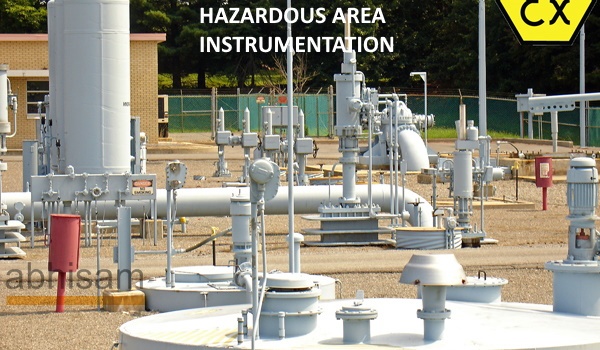
* Easy Self Paced , structured eLearning Course, access online 24/7
The Abhisam Hazardous Area Instrumentation e-learning course was the first of its kind when launched in the year 2004. Now after 14 years on, with several revisions and updations, it is the best learning resource on the topic that you can find anywhere. Used by professionals in many industries such as Oil and Gas, Chemicals, Mining, Power Generation, Shipping, Industrial Automation, Engineering Consultants and governmental organizations, it remains the premier training course for this subject all over the world!
* Understand Hazardous Area Concepts easily via Animations and Simulations, videos
A picture is worth a thousand words and an animation is worth a thousand pictures! Learn all important aspects of hazardous area instruments via engaging animated nuggets that show you how explosionproof enclosures work, how threaded joints and flanged joints work to protect enclosures, how intrinsic safety barriers and isolators work and many more!
* Real Life examples including photos from plants and facilities
When you get the Abhisam e-learning course, you are not buying some outdated textbook or pdf, you are getting decades of experience of hazardous area experts who have spent their lifetimes in industry. So the examples that are used to explain and photos are from actual industrial facilities and devices.
* Save on Travel and Stay costs. Learn at your own pace.
Getting this course means not having to travel somewhere to learn about the topic. Learn at your own pace, maybe just a hour everyday or whenever you feel like it. No need to travel to a faraway place and spend time and money on travel or stay. Learn in the comfort of your own office or home, or even on the beach! We make geography, history.
* Get Certified as a Hazardous Area Professional (earn a Certificate with lifelong validity and an electronic Badge)
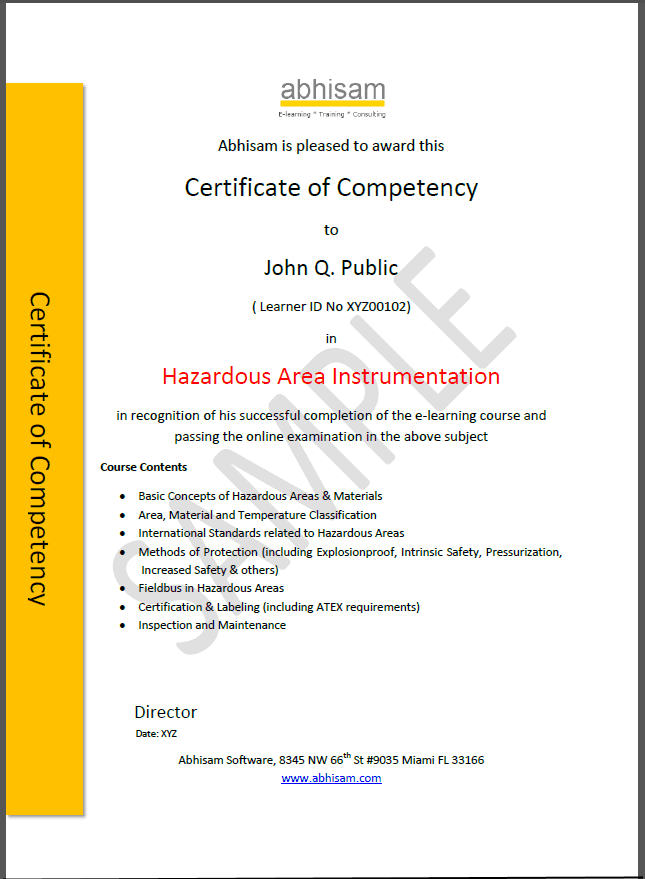
We enable you to earn a Certificate of Competency in Hazardous Area Instrumentation, with lifetime validity, at no additional charge! Also get an electronic Badge that can be displayed online on places such as LinkedIn or Facebook, to let your peers, bosses and clients (present and future) about your skills and achievements.
Key Benefits of the Course
- Self Paced Course, learn at your own speed, whenever you wish
- Learn from home, office or anywhere else
- Access from any device PC/laptop/Mac/Tablet-no restrictions
- Includes Online Exam and Certification
- Prove your competency by displaying your electronic badge online on social media
- Full fledged e-learning course- Its not a video of a guy speaking or a pdf or a PPT
- Learn from Real life situations and case studies
Get Certified as a Professional! Earn an electronic badge that you can display online.
Customer Feedback
We are the Gulf of Suez Petroleum Company, one of the major Oil & Gas production companies in EGYPT. I would like to express our good impression on such course. It is one of the most comprehensive, information rich and fun at the same time regarding Hazard area classification and its equipment installation practice.
Best regards for the abhisam company!
Instrumentation Department
GUPCO, Egypt
Learners from Marquee Companies
This course is the oldest e-learning course in Hazardous Area Instrumentation worldwide! Updated continuosly, this is now the fifth version since it was first introduced in 2003. Engineers and Managers from marquee companies have learned via this course, only a few examples are shown below







The course has real life examples from actual projects and operating plants/ installations that give you a step by step method to do work related to Hazardous Areas. For example, here’s an example from the section on Intrinsic Safety.
Example: This example is given as a guideline, to demonstrate how an Intrinsically Safe loop is designed. We have to implement an open loop (tag No TI-101) for temperature measurement, consisting of a thermocouple and a temperature transmitter, using the principles of Intrinsic Safety. The Safe area equipment which will be connected to this is a DCS. The Thermocouple is mounted in a thermowell on a process reactor. This reactor is located in a hazardous area classified as Zone 1, Group II A, T4.
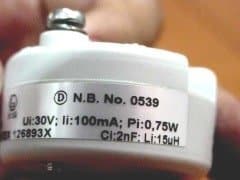
Do you know how to do this? Learn it in the course.
After you complete all the modules in the training program, you can take the Self Assessment Test which enables you to gauge your own understanding of the subject. This also acts as a mock test, before you take the online Certification Exam. Here’s a screenshot of one of the Questions.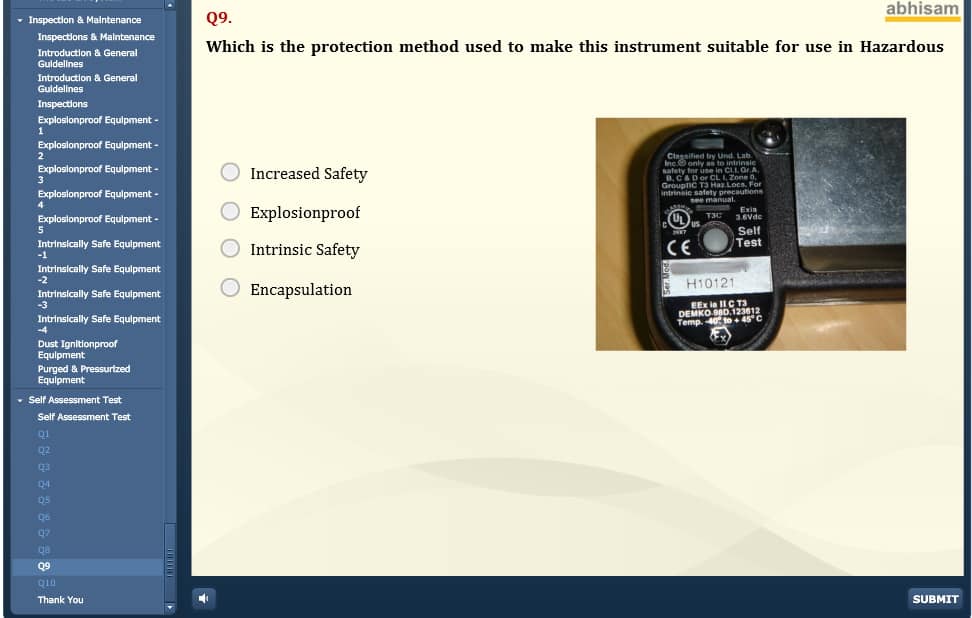
Are you an employer? (Manufacturing or Engineering Consulting company or Industrial Automation supplier or a Contracting Company)
You know that it’s YOUR responsibility to train your employees… So what are your options?
You could ignore training requirements opening yourself up to MASSIVE liabilities if your employees are injured or killed on the job or you lose some of your plant assets to fires and explosions…You could be out of business… Or even worse… Almost instantaneously…
You could pay thousands of dollars to send employees to live training workshops, or several hundreds of dollars on study guides, books and courses…
OR you can buy this interactive training course that has proven to be the fastest and easiest way for employees to learn… And RETAIN… Information about this important subject.
We make the learning process fun and easy. Our e-learning course is full of graphics and animations/ simulations that are entertaining to watch, incredibly simple to understand, and provide the fastest and easiest way to learn everything you need to know about this complex subject..when you go through the program, Hazardous Area Instrumentation will no longer appear complex.
We’ll Teach You Everything You Need To Know regarding this… And We’ll Make It More Fun To Learn, Easier To Understand, And More Cost Effective Than Any Other Training Solution… Guaranteed!
Special Enterprise Pricing for companies! Scroll below to see options.
Just for your information, here are some of the accidents in the news…reported and investigated by the Chemical Safety Board. Directly related to lack of knowledge about hazardous areas.
Choose from any of the versions.
Scroll below to see complete contents.
Standard
For one learner-
Course Duration: 16 hours of self paced learning (Earn 16 PDH)
-
Access the course online 24/7 via any device for one year
-
Exam & Certification for one learner
-
Lifelong Valid Certificate
Professional
For one learner-
Everything in Standard plus
-
Access the course for 3 years
Get Access to all Abhisam Trial courses, including this Hazardous Area Instrumentation course for $7. You will NOT be billed automatically after trial ends.
Note: Trial versions of courses have only the first few modules viewable.
Table of Contents
Introduction to Hazardous Areas
History related to Mines
Miners Safety Lamp
Flammable Liquids, Gases & Vapors
Fire Triangle
Explosive Limits
Hazardous Atmosphere
Effects of Temperature & Pressure
Ignition Energy
Flash Point
Autoignition Temperature
Dust Hazards
Explosion Pentagon
Why do we classify hazardous areas?
More about classification
Different Types of Standards
Standards Bodies -IEC
Standards Bodies – NFPA
Area Classification for Gases & Vapors (IEC)
Area Classification for Gases (IEC)
Area Classification for Dust atmospheres (IEC)
Area Classification for Dusts (IEC)
Material Classification (IEC)
Material Classification (IEC) – Examples
MESG (Maximum Experimental Safe Gap)
Minimum Ignition Current (MIC)
MIC Ratio
Temperature Classification (IEC)
Classification of Hazardous Locations (American System)
Material Classification for Gases & Vapors (North American System)
Classification of Gas Groups (North American System)
Comparison between IEC and the North American System
Article 505 of the National Electrical Code
Area Classification of Dusts (North American)
Dust Groups (North American)
Area Classification for Fibers and Flyings (North American)
Temperature Classification (American System)
Summary-IEC
Summary-NEC
Step by step Area Classification for Gases & Vapors
Pitfalls in the Classification Process
Area Classification for Dusts
Example of Area Classification
Introduction to ATEX
The ATEX Directives
The ATEX Directive 94/9/EC-1
The ATEX Directive 94/9/EC-2
ATEX Equipment and Categories
ATEX suitability table
ATEX Directive 1999/92/EC-1
ATEX Directive 1999/92/EC-2
ATEX Directive 1999/92/EC (contd)-3
ATEX 2016 Updates
Integrated Explosion Protection
Non Electrical Ignition
Traceablity
ATEX Exclusions
Overview of Protection Philosophy
Explosionproof Method (IEC Code Ex-d)
Explosionproof Fundamentals
Explosionproof Working
Pressure development in an enclosure
Pressure Piling
Explosionproof MESG
Standards & Practices for Explosionproofing
Explosionproof Seals
Explosionproof IEC
Dust Ignition Proof
Explosionproof Advantages
Explosionproof Disadvantages
Intrinsic Safety (IEC Code Ex-i)
Intrinsic Safety Basics
Intrinsic Safety – Resistive Circuits
Intrinsic Safety – Inductive circuits
Intrinsic Safety Capacitive
Minimum Ignition Current (MIC)
Resistive Circuit Curves
Curves for Gas Group IIC
Capacitive Circuit Curves
Inductive Circuit Curves
Intrinsic Safety – Simple Apparatus
Intrinsic Safety Apparatus
Intrinsic Safety Barriers – Diodes
Intrinsic Safety Barriers – Zener Diodes
Ordinary Diode Curves
Zener Diode Curves
Functioning of a safety barrier
Safety Description of barriers
Zener Barrier example
Zener Barriers – Earthing
Isolators
Isolator details
Infallible Components
Entity Concept
Cable Parameters and L/R ratio
Ex-ia, Ex-ib, Ex-ic
Intrinsic Safety Parameters – 1
Matching of IS parameters
Designing an Intrinsically Safe loop – example
Designing an IS loop (contd)
Intrinsic Safety – Advantages & Disadvantages
Pressurization & Purging
Types of pressurization
Pressurization Interlocks
Purging Types X, Y and Z
IEC Types Ex-px, Ex-py and Ex-pz
Pressurization – Advantages & Disadvantages
Increased Safety – Introduction
Increased Safety – Construction
Creepage and Clearances
Overloads
Increased Safety – Advantages & Disadvantages
Nonincendive equipment
Non Arcing Equipment
Differences between Ex-nA and Ex-nL
Nonincendive Equipment – Advantages & Disadvantages
Encapsulation
Encapsulation
Powder Filling & Oil Immersion
IEC Equipment Protection Level
IEC Protection Methods Table – Gas/Vapor
IEC Protection Methods Table – Dusts
Weather Protection
NEMA Codes – Indoor Non hazardous locations
NEMA Codes – Outdoor non hazardous locations
NEMA Rating for Hazardous Locations
Ingress Protection Codes
IP Codes Chart
Comparison between IP and NEMA
Fieldbus in Hazardous Areas
Using traditional explosionproof methods
Fieldbus using Intrinsic Safety
Fieldbus Entity Calculation Example
FISCO
FISCO Topology
FISCO Conditions
FISCO Advantages
FNICO
FNICO with repeaters
FNICO and Ex-ic
Field Barriers & High Energy Trunks
Introduction
Certification Bodies
Marking & Labeling
ATEX Marking
Marking & Labeling -Example
Testing
Hexagon Ex and CE Marks
Marking & Labeling -Example
The IEC Ex System
Introduction & General Guidelines
Inspections
Explosionproof Equipment
Intrinsically Safe Equipment
Dust Ignitionproof Equipment
Purged & Pressurized Equipment
The Self Assessment Test is a practice mock test that helps you prepare for the Hazardous Area certification exam
Just get this Hazardous Area Instrumentation training course today for a much lesser price than any other course out there
No other course (Classroom or e-learning or software or online or video or any other) includes all of these modules in one course!
Can I not get this information free from elsewhere?
There is a myth “Just Google it”
Unfortunately it is not true. If you Google for it you are likely to get a large number of Hazardous Area Instrumentation related articles, videos, ebooks and other material. You may also get a lot of information about explosionproof instruments, intrinsically safe instruments, safety barriers, galvanic isolators, purged panels and mich more.
However, none of these will teach you
How does an Explosionproof enclosure actually work? (Find out in our animations)
How does it contain the explosion?
How much pressure gets developed inside?
Why are there different criteria for Group IIA, IIB and IIC instruments?
What does the ATEX mark mean?
What is the difference between flange covers and screwed ones? What do you mean by flamepath?
How do you design an Instrument loop using Intrinsically Safe instruments? How do you match the parameters of the zener barrier or isolator to the instrument?
What is the importance of cables?
You will find all your questions answered here and many with animations so that you can easily grasp complex concepts.
Also, Earn a Certificate of Competency in Hazardous Area Instrumentation, when you pass the associated exam and also get an electronic badge that can be displayed online on places such as LinkedIn. Get Noticed as an Expert!
Can I not simply buy a book? That will be much cheaper!
Of course, you could always pass this up and decide to go for buy a book on this topic,
but,
remember that there are some disadvantages with this approach
a) The first is that not a single book is available on the market, that covers all the topics that you need to know. On the other hand, there are a lot of things in every book, that you can safely skip, without missing anything.
b) Some of these books may be outdated and obsolete as the standards keep on getting updated whereas the book remains as it is.
c) Watching an animated simulation makes you grasp a concept much faster than merely reading about it.
and Finally,
d) Nobody gives you a certificate if you simply read a book.
What does the $7 trial include?
The $7 trial includes trial access to ALL the courses in the Abhisam Catalog for a limited time.
After the trial is over you can choose to either buy an individual course OR subscribe to the GOLD or PLATINUM membership plans. Your card will not be billed automatically.
Which versions are available?
This course is available as either stand alone (select the Standard version above), Professional, or as part of the Abhisam GOLD membership level.
The Standard version allows you to access the course online from any device (PC/tablet/smartphone) that has an internet connection and a browser that supports HTML 5 (such as Mozilla Firefox, Google Chrome, Internet Explorer, Microsoft Edge, Opera, etc). You can access the course for a period of one year, within which you need to take the exam to earn a Certificate (electronic). You will also earn an electronic badge that can be displayed online on LinkedIn and similar portals.
The Professional version allows you to access the course online for 3 years from any device (PC/tablet/smartphone) that has an internet connection and a browser that supports HTML 5 (such as Mozilla Firefox, Google Chrome, Internet Explorer, Microsoft Edge, Opera, etc). You can access the course for a period of three years, within which you need to take the exam to earn a Certificate (electronic). You will also earn an electronic badge that can be displayed online on LinkedIn and similar portals.
The content in the Standard and Professional versions is the same.
What is the Abhisam GOLD membership?
When you subscribe to the Abhisam GOLD membership, you get access to all the courses in the Abhisam Catalog, by paying just one low monthly subscription. You can also get a free certification exam every month. If you are interested in taking a bunch of courses, then the GOLD membership gives you an affordable plan to do this. This is available to individuals only.
What is the Abhisam Platinum membership?
This is meant for organizations with multiple learners. When you subscribe to the Abhisam Platinum membership, your learners get access to all the courses in the Abhisam Catalog, by paying just one low Enterprise yearly subscription. You can also get a free certification exam every month. Additionally you also get a Dashboard where your Training Manager can see the progress of the learners, such as learner module completion, login times, test scores, etc.
Other Hazardous Area Courses
Hazardous Area Classification with certification
The only affordable and easy course on hazardous area classification!
Learn from real life examples, how to classify hazardous areas (includes both IEC and NFPA/NEC), calculate the extent of hazardous areas, ventilation considerations, make hazardous area classification drawings and more!
Includes a free Certificate of Competency and an electronic badge when you pass the exam.
FREE Hazardous Area Course!
Take this FREE Hazardous Areas training course and learn the basics online at your own pace.
Covers concepts of fire, explosion, LEL, UEL, Flash Point and other fundamentals.
Optional (paid) Certificate available.
Questions?
Contact Us by filling the form below OR call us OR email