Copyright 2009-2010. Abhisam Software. All rights reserved
A comprehensive e-learning course on
Safety Instrumented Systems
Covering more than any other course available today at a price that is less than any other!

Dear Friend,
You are here, reading this page, because you are well aware of the role of Safety Instrumented Systems, in protection of assets and people. In recent years, there have been extensive studies on the best ways of making our process plants safer and the conclusion is that by just doing one thing right, which is -increasing the reliability of the Instrumentation and Control systems in a plant, can make these plants much safer.

On the other hand, negligence in respect of Safety Instrumented Systems can be really disastrous, literally. Look at just a few recent cases below

Caribbean Petroleum, Puerto Rico, 2009
A massive fire and explosion sent huge flames and smoke plumes into the air at the Caribbean Petroleum Corporation near San Juan, Puerto Rico. The resulting pressure wave damaged surrounding buildings and impacted moving vehicles. Preliminary cause found, was non working of the overfill protection system (part of the Safety Instrumented System).

Petrolia, Pennsylvania, USA, 2008
Thousands of residents of surrounding areas had to be evacuated to safer places when there was a release of large quantities of Oleum (fuming Sulfuric acid), from a chemical plant. The root cause was determined to be non implementation of a proper Safety Instrumented System.

Danvers, Massachusetts, USA, 2006
Massive explosion at an ink processing plant causes destruction of plant as well as surrounding homes, injuring many residents of surrounding areas. Cause? Lack of safety interlocks and automatic shutdown systems (in other words a Safety Instrumented System) in the plant.

Morgantown, North Carolina,USA, 2006
Explosion at a polymer manufacturing plant led to total damage of the facility, with a human fatality and several injuries. Investigations found out that a lack of process safety standards and non implementation of automatic interlock systems (in other words, Safety Instrumented Systems) as the root causes of the disaster.

Buncefield, UK, 2005
The Buncefield industrial disaster was one of the biggest disasters to strike the chemical and petrochemical industry in Europe in recent years. The blasts that occurred were so loud, they were heard as far away as France! (Buncefield is in the UK) The root cause was found out to be a probable malfunctioning Safety Instrumented System in one of the plants on the site.

The list goes on and on.....

Of course, you agree, that Safety Instrumented Systems are essential and are operational in many plants and facilities around the globe. But mere operation and existence of such a system, does not ensure, that it will always work as designed , is it not?

You need to know it in depth, to make it work for you.

To make it work for you, you need to know these systems thoroughly ( I mean not from a programming point of view but from a users point of view). You need to get trained in all the concepts and ideas of Safety Instrumented Systems. Note that here,  when we refer to Safety Instrumented Systems, we also include Emergency Shutdown Systems (ESD), Safety Shutdown Systems, High Integrity Pressure Protection Systems (HIPPS) and all similar systems that are used to ensure the safe operation of plant and machinery, using instruments, electrical and pneumatic/hydraulic devices.

However, the  jargon associated with these sophisticated process control systems is so put-offing and even confusing, that even experienced professionals cringe at the mention of Triple Modular Redundant, 2oo3 voting, SIL 3 or IEC 61508.

Does it really have to be this way?

No! Not really.

You can get this e-learning course on Safety Instrumented Systems and learn all about these systems, in the comfort of your home or office.

Just download this Safety Instrumented Systems e-learning course today and for a fraction of the price that you would otherwise pay for a classroom training course, learn everything that you wanted to know about SIS (but didn't know whom to ask).

Of course, you could always pass this up and decide to go for that seminar or classroom training, whenever that is offered , or buy a book on this topic,

but,

remember that

a) this early bird price will not last for long 

b) you will forget all about this, till the time comes for you to explain to somebody higher up, as to why you installed the 2oo3 Safety Logic Solver  instead of the alternate 1oo2 Logic Solver , OR (God forbid)-you have to explain to a government inspector why you felt that SIL 1 was adequate for your Safety Instrumented function instead of a SIL 3 that he felt should have been required.

c) you will , once again, be conned into buying a SIL 3 transmitter from that smooth talking vendor (there is no such thing as a SIL 3 transmitter BTW-find out why in the course)

d) You forget about this e-learning course completely. Then you enroll yourself in an expensive $ 2500 classroom course, travel halfway around the globe to attend it, spend some more of your undernourished training budget on it  and then forget whatever you learned when the time comes to finally apply the concepts learned in your work.

e) You decide to skip this offer and opt to buy a book (or books) on this topic. However, there are a couple of problems. The first is that not a single book is available on the market, that covers all the topics that you need to know. On the other hand, there are a lot of things in every book, that you can safely skip, without missing anything. Thus, if you wish to source your knowledge of Safety Instrumented Systems from books, you will have to buy not one but several. They also cost a pretty penny (are not cheap at all). The cost of just two of them will be more than the price of this course

So, why don't you simply download this first of its kind training course on Safety Instrumented Systems and

a) Be assured that you have the best course on Safety Instrumented Systems in an e-learning format.

b) Have access always, to the entire course (it will reside silently on your computer  24/7), for as long as you retain your computer. There is no recurring license fee. This means once you buy a license, you can access it for as long as you wish, on the same computer.

c) Get a comprehensive course that has several Flash based animations and rich graphics, explained in a very simple to understand way, with accompanying text, that will remove all the "complexity" that is normally associated with this subject.

Go ahead and BUY IT.  Still unsure?    Download the free trial  here.

The investment amount is only $ 177 US at present , which will be increased shortly, once the early bird offer ends. Comparable classroom courses, from other providers, cost in the range on thousands of dollars.  There are also some online courses from some other service providers, but they are available in Modules (you have to pay a weekly access to view these modules).

Your total cost would be surely much more than the $ 177 that you would pay to DOWNLOAD this course.
MODULE 1- Introduction to SIS
  • What are Safety Instrumented Systems?
  • Basic Ideas about SIS
  • Functional Safety
  • Instrumented Systems & Safety Instrumented Systems
  • BPCS
  • BPCS and SIS
  • Safety Instrumented Function
  • Safety Instrumented Function-2
  • Safety Instrumented Function-3
  • Emergency Shutdown Systems
  • Need for a separate SIS
  • Simulation exercise
  • Learnings from the exercise
  • Typical architecture
  • Integrated BPCS & SIS
  • Integrated BPCS & SIS-2
  • Examples
  • Differences between BPCS & SIS
MODULE 2-Hazards, Risks & their analysis
  • Hazards & Risks
  • Types of hazards- Fire & Explosions
  • Types of hazards-Toxic Material
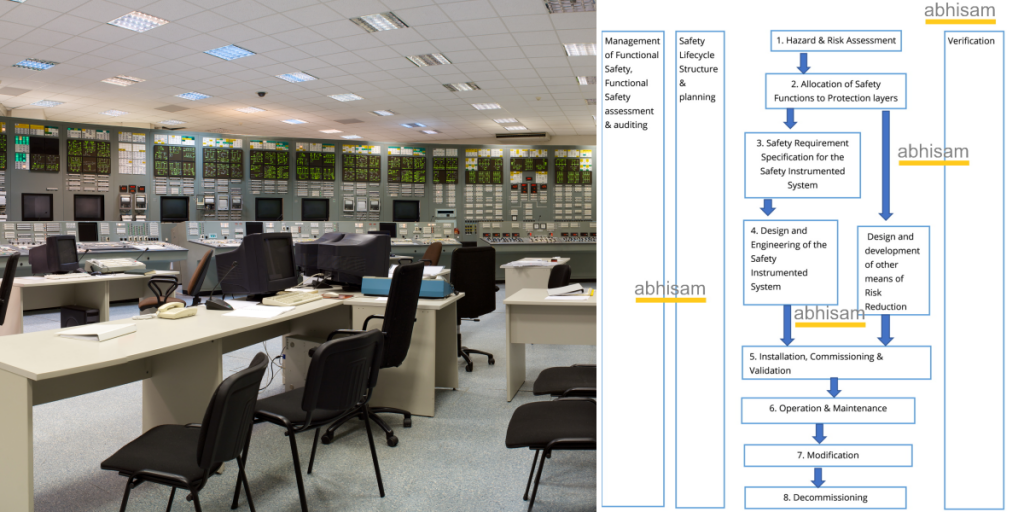
  • The Safety Lifecycle
  • Steps in analysis
  • Preliminary Hazard Analysis
  • HAZOP
  • HAZAN
  • Consequence Analysis
  • Risk
  • Risk graph
  • Risk Reduction
  • Risk Reduction-2
  • The ALARP principle
  • Risk Reduction in process plants
  • Risk Reduction explained
  • Risk reduction using an SIF
  • Risk reduction using an SIF
  • Layers of Protection
  • Layers of Protection in the process industries
  • Preventive & Mitigative layers
  • Safety Requirement Specification
  • Safety Requirement Specification-2
  • Diversity
MODULE 3-Failures & Reliability
  • Failures
  • Types of failures
  • Types of failures-2
  • Types of failures-3
  • Dangerous & Safe failures
  • Dangerous & Safe failures
  • Safe Failure Fraction
  • SFF Pie Chart
  • Proof Test Interval
  • Diagnostic Coverage
  • Common Cause Failures
  • Common Cause Failures-2
  • CCF Example
  • Diversity
  • Reliability
  • Failure Rate
  • MTTF
  • MTTR
  • MTBF
  • Failure Data
  • Software Reliability & fault injection
  • Reliability Block Diagrams
  • Reliability Block Diagrams-2
  • Reliability Block Diagrams-3
  • Redundancy and Reliability
  • Fault Tree Analysis
  • Fault Tree Analysis Example- 1
  • FTA and RBD
  • Fault Tree Analysis Example-2
  • Fault Tree Analysis Example-2
  • Fault Tree Analysis-Probabilities
  • Event Trees
  • Event Tree Components
  • Event Tree Analysis Example
  • Fail-Safe and Fail Danger modes
  • FMEA
  • FMEDA
  • FMEDA report
  • How to use the FMEDA report
  • Redundancy
  • Redundancy and Voting
  • Voting Systems 1oo1
  • Voting Systems 1oo2
  • Voting Systems 1oo2D
  • Voting Systems 2oo2
  • Voting Systems 2oo3
  • Spurious Trips
  • Concept of Demand
  • Low Demand & High Demand
  • Demand in a plant
  • PFD
MODULE 4-Safety Integrity Level
  • Introduction to Safety Integrity Level
  • What SIL is not
  • Is SIL applicable to me?
  • SIL 1 to SIL 4
  • SIL for Demand Mode
  • SIL for Demand Mode-Example
  • SIL for Continuous/High Demand Mode
  • The SIL process
  • Common SIL questions
  • Common SIL questions-2
  • Target SIL-Qualitative & Quantitative methods
  • Risk Reduction Factor-1
  • Risk Reduction Factor-2
  • Safety Availability and PFDavg
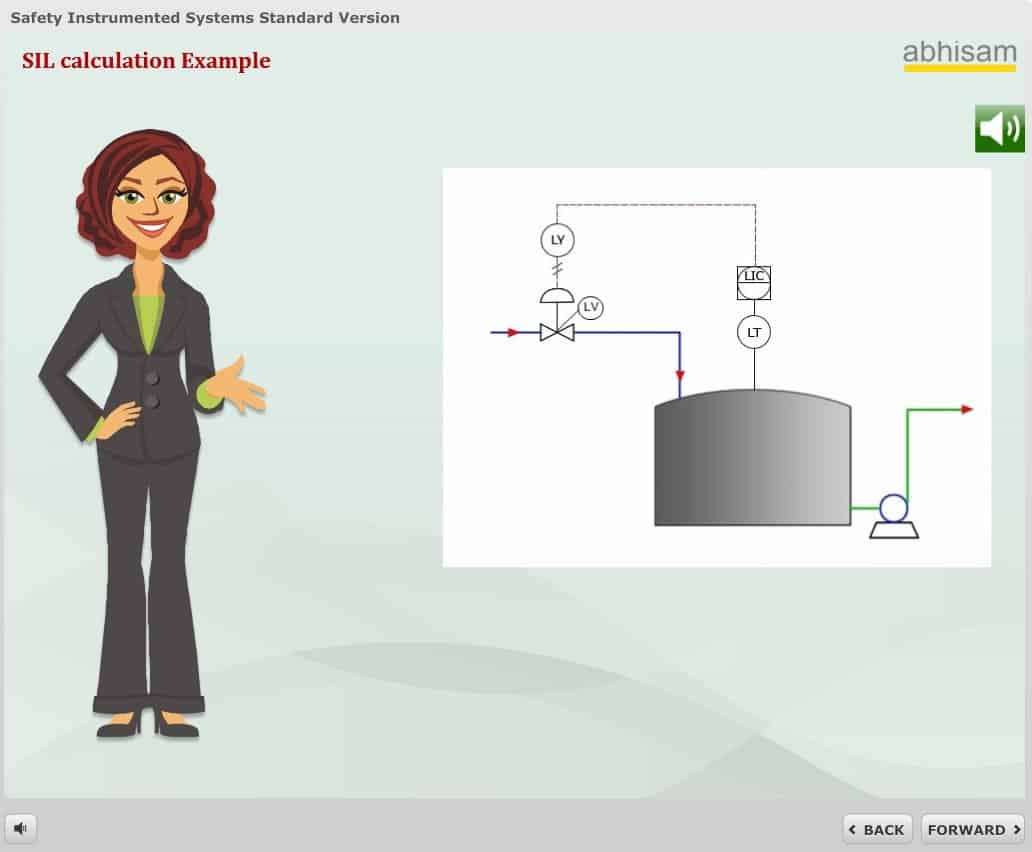
  • SIL calculation Example
  • SIL calculation Example
  • SIL calculation Example (contd)
  • SIL calculation Example (contd)
  • SIL calculation Example (contd)
  • SIL Calculation example-(modification)
  • SIL Calculation example-additional layers
  • SIL Calculation example-caution
  • Consequence Only Method
  • Hazard Matrix Method
  • Hazard Matrix Method- (contd)
  • Hazard Matrix Method-Example
  • Risk Parameter Graph-1
  • Risk Parameter Graph-2
  • Risk Parameter Graph-3
  • LOPA method
  • Conducting a LOPA
  • LOPA method
  • LOPA Example
  • LOPA Example contd
  • LOPA Example contd 2
  • LOPA Example contd 3
  • SIL verification basics
  • PFD of simple loop
  • SIF design process
  • SIL verification
  • Architectural Constraints
  • Architectural Constraints IEC 61508
  • Hardware Fault Tolerance-IEC61508
  • Architectural Constraints-Example
  • Hardware Fault Tolerance (contd)
  • Architectural Constraints-Example
  • Hardware Fault Tolerance-IEC61511
  • SIL verification methods
  • Simplified Equations
  • Use of Simplified Equations-Example
  • Markov Modeling-1
  • Markov Modeling-2
  • Markov Modeling-3
  • Markov Modeling-4
  • SIL verification example
  • SIL verification example-2
MODULE 5-SIS Standards
  • Introduction to Standards in SIS
  • AK 1 to AK 8
  • IEC Standards
  • IEC 61508
  • IEC 61508-Safety Life Cycle
  • IEC 61511-Basics
  • Relationship between IEC 61508 & IEC 61511
  • ISA S84 Background
  • Practical applications
  • What standards apply to me?
MODULE 6- SIS in practice
  • Components of the Safety Loop
  • Types of logic Solvers
  • Hardwired logic solvers-Trip amplifiers
  • Hardwired logic solvers-Gates
  • Safety Relays-Electromechanical
  • Safety Relays-Electromechanical-2
  • Safety Relays-Electromechanical-3
  • Safety Relays-Electromechanical-3
  • Safety Relays-Electromechanical-4
  • Safety Relays-Electronic
  • Safety Relays-Electronic-2
  • Safety Relays-Electronic-3
  • Programmable Logic Solvers
  • Safety PLCs & General Purpose PLCs
  • Fault Diagnostics
  • Safety PLCs- Inputs
  • Safety PLCs-Processors
  • Safety PLCs- Outputs
  • Safety PLCs-Software
  • Safety PLCs-Software-2
  • Safety PLCs-Software-Design
  • Safety PLCs-Voting architecture
  • Safety PLCs-TMR
  • Safety PLCs-QMR
  • Safety PLCs-Interface to BPCS
  • Safety Networks-1
  • Safety Networks-2
  • HIPPS
MODULE 7-SIS Testing & Maintenance
  • Need for testing
  • Testing-Example
  • Breakup of failures
  • Testing the components of a SIS
  • Testing Sensors & Transmitters
  • Testing Logic Solvers
  • Testing valves
  • Valve Testing-Bypass method
  • Partial Stroke Testing
  • Partial Stroke Testing-ISA method
  • Valve Testing- Mechanical Stoppers
  • Valve Testing-Smart Positioner method
  • PST-Advantages & Disadvantages
  • Self Assessment Test
COURSE TABLE OF CONTENTS
You have seen how detailed and comprehensive this course is, as compared to any other course anywhere. So what are you waiting for?

Download it now!

100 % satisfaction guaranteed.

If you find that this course is not worth the price or it does not work for you for any reason within a period of 30 days, then we will refund you your full money back!
 
Safety Instrumented Systems
Download a free trial now!

Windows Vista and Windows 7 users please note: After downloading the zip file and extracting it, please right click on the program icon and select "Run as Administrator"

HONESTe Online Member Seal Click to verify - Before you buy!
Download a free trial now!

Note: The trial is the first module of the course, to give you an idea of the course. Remember when you buy the full version, you will get ALL the modules given below in the Table of Contents.

Windows Vista and Windows 7 users please note: You must have administrative rights on your computer to run this program. In case of errors, please right click the icon (after unzipping the file) and select "Run as administrator" from the menu.

You can also pay by Bank Transfer, Wire transfer, Webmoney, Paypal, physical check and several other methods. Please click on the "Add to Cart" button and follow the steps.
Welcome to Abhisam Software - the leader in technical training!
Note: 1. For companies and other organizations who wish to tweak this course, we also offer
                 CUSTOMIZATION options. Please send your query to sales@abhisam.com
             2. We can also offer a HOSTED option. This allows learners to take the entire course ONLINE
                  without DOWNLOADING any software at all. Reports of learner login times, scores can be
                  provided.

Includes how to assess and verify Safety Integrity Level (SIL)
Download a free trial now!

Windows Vista and Windows 7 users please note: After downloading the zip file and extracting it, please right click on the program icon and select "Run as Administrator"

Download a free trial now!

Windows Vista and Windows 7 users please note: After downloading the zip file and extracting it, please right click on the program icon and select "Run as Administrator"

Download a free trial now!

Windows Vista and Windows 7 users please note: After downloading the zip file and extracting it, please right click on the program icon and select "Run as Administrator"

Includes how to assess and verify Safety Integrity Level (SIL)