
Manage Hazardous Areas effectively using Gas Monitors
Abhisam Whitepaper explains how you can manage hazardous areas in your plant or facility by using gas detectors.
EXECUTIVE SUMMARY
Hazardous areas are those locations that could have hazardous levels of explosive gas, vapor or dust mixtures present that could potentially ignite and cause fires or explosions. Such locations are normally found in oil & gas processing, chemical & petrochemical plants, shipping terminals, warehouses , aircraft fueling depots and similar locations.
Equipment that is to be installed in such locations is different from general purpose equipment (both electrical and non electrical). It has to be explosion protected and certified for the area in which it is to be used.
Thus all equipment installed in hazardous areas, necessarily has to conform to the area classification for that area. However, frequently, practical problems arise, where the specified equipment may not be easily available. For example, an area classified as Zone 1 under the IEC system, theoretically can accept only Zone 1 equipment. However sometimes, especially in case of specialized equipment, Zone 1 certified equipment of that type may not be available.
At the same time the area could have a good coverage of explosive gas monitors which are in excellent condition (selected and installed correctly, regularly tested, calibrated, inspected and maintained properly).
In such cases what could be done? This paper presents the background of such situations, possible solutions and current practices regarding this issue.
Disclaimer: This Abhisam whitepaper provides some possible scenarios that may not apply to your situation, or may be void due to regulations in your jurisdiction. You are cautioned to exercise your own engineering judgement in these cases. Nothing that is mentioned here can be construed as engineering, legal or safety advice.
Introduction
Places containing combustible or flammable mixtures of vapors, gases and dusts are generally classified according to the likelihood of the flammable mixture being present and the nature of the mixture so present. Hence these areas are known as Hazardous Areas (Classified locations). Typically these locations would be chemical plants, oil refineries, gas processing plants, tank farms, grain storage silos, etc.
These places are generally classified on the basis of two widely applied systems, one is the American system ( NFPA Class, Division & Group based) and the other one is the European/ IEC system (based on Class, Zone, Group). Various National as well as International standards follow either one of these two systems.
Area Classification
Based on the location of your plant or facility, either one of the two systems above would be used to do the area classification.
Now let us take an example of an upcoming petrochemical manufacturing plant in Happyville. The entire plant is supposed to process petrochemicals and has several areas classified as hazardous. The plant is presently under the engineering design stage. During this stage, it is classified by the engineering and safety gurus/ consultants and the local authorities as “hazardous”. It has been agreed by the owners and the engineering consultants, to use the IEC system for Hazardous Areas.
Thus, various markings on engineering layout drawings now show the various locations as Zone 1, Zone 2 and so on. Then during the next stage of the project, suitable equipment is ordered, the plant is constructed and commissioned and starts producing petrochemicals safely.
What next?
The fairy tale ending of “Everyone lived happily ever after” does not happen.
Why? Let us move a little further ahead in the lifecycle of this plant, say two years, after it has been commissioned.
Subscribe to our Newsletter to get more white papers.
Zone 2 equipment in Zone 1 areas?
Suppose there is an equipment in this plant that is certified for Zone 1 and which is installed, also in an area designated as Zone 1. Now after two years of running, it has a major failure and needs replacement. You are the Plant Engineer and are assigned the task of replacing it. You look up the spec sheet and try to contact the original equipment manufacturer. You learn that the manufacturer has stopped producing that kind of equipment because of tough competition and no longer can supply it. He however, helpfully gives you the name of another manufacturer, who makes similar equipment. You are glad to get the information and contact the new guy.
Whew! What a relief! You learn that he can supply his model which will suit your purposes admirably well, except for one (minor?) detail. The equipment is not certified for use in Zone 1, but only for use in Zone 2.
Thus , it can only be installed in Zone 2.
You now have a problem. You understand that you cannot install an equipment that has been certified as suitable for Zone 2, into a Zone 1 classified area, as it would be violating the law, good engineering practice, safety standards and so on. So what do you do?
Let us examine your options
a) Install it anyway!-Not recommended at all, as it would not only violate the law, it could cause a disaster.
b) Re-classify it, until you get an answer you like!
(Try to get the area re-classified by another expert, to check if the area really merits a Zone 1 designation, or you can get it designated as Zone 2, or even better, a safe area!)
This option is also not recommended, since if the original design engineer has done the job well, there is no reason why he would have been wrong. You will waste time, money and energy on a futile project.
c) Look for another less-taxing job?-Not necessary, there is a fourth option, read on below!
Installing Zone 2 equipment in a Zone 1 area-Your options
Yes, you guessed right. You can install a Zone 2 certified equipment, in an area reserved for only Zone 1 equipment, legally in many countries, provided certain conditions are met. What are these conditions? Before proceeding further, let us go back to basic concepts. What is really the difference between a Zone 1 and a Zone 2 area? If you remember your fundamentals of area classification, recollect that the only difference, is in the probability of an explosive mixture of vapor/gas/dust being present.
In Zone 1, it is more probable, in Zone 2, it is less probable. It is as simple as that.
Option 1
You can try to reduce the classification of the hazardous area from Zone 1 to Zone 2, by changing certain environmental conditions, like improving ventilation in the area. Improving ventilation will ensure that enough dilution air is always present at all times, so that explosive limits of vapors/ dust concentrations are never reached. This would reduce the classification itself to Zone 2, so the problem gets solved.
You may now think, that this is exactly what was offered as an option in the previous section, where we ruled it out, why repeat it now?
This is not so. Note, that in order to really change the classification of the area, we cannot merely study it again and again and hope to get a different answer every time. We will have to change the nature of that area, by reducing the hazards present. In the option that we are discussing now, we are not merely studying the classification again, we are going to physically change the characteristics of the classified area to make it safer.
In this case by having better ventilation of fresh air into the area.
For studying the second option, let us first study the basic idea behind area classification. The idea was to segregate areas, that were at risk of having explosive vapor or gas mixtures for longer periods of time, from other non hazardous areas. Again, further sub-dividing the hazardous areas into zones (Zone 0, Zone 1 and Zone 2) gives us finer choices, for selecting certain methods of protection over others, in a cost effective way. This is in keeping with the general principles of risk reduction, using ALARP (As Low As Reasonably Possible). This basically means, that we can spend truckloads of greenbacks on installing explosion protected equipment everywhere, even in safe areas, (to really really protect ourselves), but then the cost of doing so would drive us out of business. Thus we follow the ALARP principle.
For example, Increased Safety (Ex-e) as a method of protection, is allowed in Zone 2, but not in Zone 1. Thus we can have equipment that is appropriate for use in the area without overdesigning it or being unsafe.
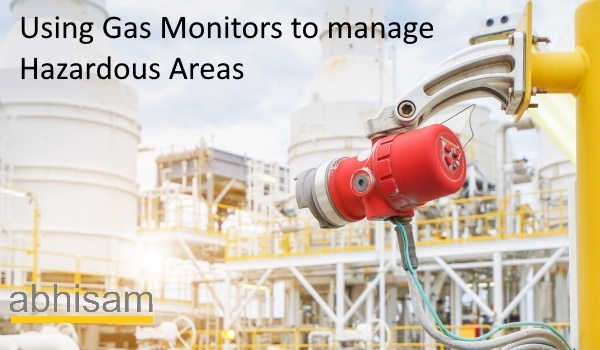
However, what if we could continuously measure the so called hazardous area and check if there really are explosive gases or vapors present? Of course, we can and to do this correctly, we can install a fixed (not portable) combustible gas detector(s) in the hazardous area and monitor it in real time, if hazardous levels of vapors are present.
Option 2
You could install a combustible gas detector, that will detect the presence of combustible gas or vapor in the area and give warning alarms, or shut off the equipment immediately, in case flammable gas is detected.
Is this allowed? Yes of course, provided certain conditions are met. This protection method is known as “Combustible gas detector method of protection”
Note: You can take a look at the Abhisam Gas Monitors e-learning course to learn everything about gas detection including explosive gas detectors, toxic gas detection, oxygen detectors and more. Also get certified.
Conditions under which this method of protection may be used
Of course this method of protection is only allowed under certain conditions and not always, as it would completely defeat the very purpose of area classification. It would also dilute the safety of the installation if used recklessly. Broadly speaking, this method of protection should be used only under the following conditions:
1. If the area to be so protected has an area classification of a higher level (like Zone 1) only because of a lack of ventilation.
2. If the area is part of an industrial or work area which would have very little public access.
3. If fixed type combustible gas monitors are used to detect the presence of combustible mixtures of gas or vapors, in the same area, near which the equipment is sought to be installed.
4. The fixed combustible gas monitor is itself certified to be used in the hazardous area under the same classification.
5. The fixed combustible gas monitor is selected, installed and mounted as per prevailing standards and regulations.
6. The fixed combustible gas detector is regularly calibrated and tested for correctness of its indication, which means its integrity is never in question at any time.
7. The fixed combustible gas detector is capable of giving out a high level alarm signal (audio/visual) on detecting explosive levels of gas or vapor mixtures in the surroundings and this alarm or trip signal should also switch off the power to the equipment in the area.
8. The gas monitor should cover the entire area which is sought to be protected.
The above are just broad guidelines and you should consult the appropriate national or international standards (or legal regulations), that apply to your installation.
Why not use it throughout the plant?
This method of protection cannot be used all over the plant. The reasons are many, but we enumerate a few below:
a) Modern plants may cover large land tracts. To cover this entire area (even just the hazardous areas) would require probably hundreds of fixed gas detectors. The costs of doing this would be huge. Again remember the ALARP principle.
b) The total cost of ownership also has to be considered. Each detector would have to have itself subject to periodic calibration & inspection, maintenance & repair.
c) It may not be practical to shut down entire plants just because of some gas leakages in certain portions of the plants.
d) Some equipment requires itself to be up and running, even in case of leakages or in presence of explosive gases or vapors. For example, alarm hooters, scrubber pumps, etc.
Conclusion
Merely having a higher level of area classification does not automatically preclude you from installing equipment of a lower area classification. A workaround for this situation is now available and consists of installing a suitable fixed type combustible gas detector, which continuously monitors the ambient air for any explosive or flammable levels of gas or vapor and takes adequate automatic alarm and trip actions to safely shut down the equipment in the hazardous area.
Further information
For further information on Hazardous Areas or Gas Monitors, please take a look at some excellent e-learning courses on these topics by us. These courses can be taken online at anytime and are very comprehensive.
More White papers
Watch this space
Contact Us by filling the form below OR call us OR email
