VFD Training | Online VFD Training Course
This is the best among all VFD Training courses online to build your skills
- Self paced e-learning course.
- Free exam and certification on course completion.
- Easy to understand graphics & animations – it is not just a video of someone speaking to students.
- Real life examples and calculations.
- Course has 7 modules that cover everything.

Key Benefits of the Course
Are you interested in learning about AC Variable Frequency Drives (known as VFDs for short)? These are also called by other names such as Variable Speed Drives, AC Drives, Inverter Drives, Frequency Drives, Adjustable Speed Drives and other similar terms. Our VFD training will make you an expert in these drives. This frequency drive training course enables students to get knowledge and skills in all aspects of VFD including understanding parameters, drive selection programming, configuration, maintenance, troubleshooting and more.
A Variable Frequency Drive is an important part of the automation system of any manufacturing plant or facility today. Nowadays, you see them being increasingly used to power motors, in not just manufacturing plants and industries, but also in office buildings, warehouses and other commercial places.
The Abhisam VFD training course gives you all that you need to easily learn and master Variable Frequency Drives.
Get deep knowledge and complete details when you take this variable frequency drive training. You will enhance your troubleshooting skills too, because you cannot do effective troubleshooting with only partial knowledge.
Automation solutions that use motors, will need VFDs, hence If you are an electrical engineer or technician, or an automation technician or automation engineer, or anyone interested in Industrial Automation then this VFD course is essential for you.
Simply get this course, you will get immediate access with instructions to access your online learning portal account and the VFD training classes. Everything is online, so your location does not matter. Abhisam students are located all over the world and work with major multinational companies.
We call it an XPRTU. (It makes you an expert).
- Self Paced Course, learn at your own speed, whenever you wish
- Learn from home, office or anywhere else
- Access from any device PC/laptop/Mac/Tablet-no restrictions
- Includes Online Exam and Certification
- Prove your competency by displaying your electronic badge online on social media
- Full fledged e-learning course- Its not a video of a guy speaking or a pdf or a PPT
- Learn from Real life situations and case studies
- Training Compliance records available for organizations
Earn Certificates and Badges
“I have worked in the International Oil and Gas Industry as a technical instructor for more than thirty years. I have both used and recommended the products of Abhisam. I recommend them highly to all engineers and technicians in our industry. No praise is too great!!
John Longden
GCGI LCGI. Senior Trainer
Petroleum Training Institute, UK“
Who takes Abhisam courses?
Abhisam self paced e-learning courses are taken by learners from all over the world, including those from marquee companies like the ones below.
Here is a sample question from the Self Assessment Test incl. in the course.

Table of Contents
- Welcome
- Introduction to the Course
- Introduction to AC Motor Drives
- Better Load Matching
- Focus on AC Motors
- What you will learn
- VFDs, VSDs, ASDs, VVVF Converters, Inverters
- AC Motors
- An ac induction motor
- An AC Induction Motor working
- Speed Control of ac induction motors
- Speed of an AC Induction Motor
- Power, Speed and Torque
- Torque
- Lifting Torque
- Torque for different types of loads
- Locked Rotor Torque
- Motor characteristics and types
- Design A Motor
- Design B Motor
- Design C Motor
- Design D motor
- Design E Motor
- Which type is best for my application?
- Load torque characteristics for different kind of loads
- Load torque characteristics Animation
- Classification of loads
- Constant Torque loads
- Variable Torque loads
- Constant Power loads
- Four Quadrant Operation
- Overview of AC motor controls
- DOL starter (Direct On Line starter)/Across the line starter
- Star (Wye) and Delta connections
- Control with a VFD
- Why use VFDs?
- Advantages of using a VFDs
- Disadvantages of VFDs
- Industrial applications of VFDs
- Self Assessment Test
- Introduction to the module
- Overall Design
- Rectifier Block
- DC Link Block
- Inverter Block
- Controller Block
- How it all works together
- VFD parts & VFD components
- Diode
- Diode Curve
- Switching frequency of diodes
- Rectifier Circuits
- Freewheeling Diode
- Full Wave Rectifier
- Three Phase Rectifiers
- Rectifier Circuits-Representation
- Thyristors (Silicon Controlled Rectifiers-SCRs)
- Thyristor Firing Angle
- Three Phase Thyristor Rectifiers
- DC link block
- Soft Charge Circuit
- Inverter Block
- Transistor (BJT)
- Working model of a transistor
- Transistor as an amplifier
- Transistor as a switch
- MOSFET
- IGBT
- Pulse Width Modulation
- How does PWM work
- PWM Waveform Generation
- Changing the PWM amplitude
- Changing the PWM frequency
- Noise effects of PWM inverters
- Self Assessment
- Introduction to the module
- Introduction
- Schematic of a typical VFD
- Starting/Stopping of the motor
- Acceleration/Deceleration
- Ramping
- Speed Limits
- Speed Changing
- Forward/Reverse operation
- Motor Thermal Overload Protection
- Braking
- Braking- Electrical or Mechanical?
- Electrical Braking using VFDs
- Motoring and regeneration
- Braking Resistor
- Dynamic Braking
- Regenerative Braking
- Slip Compensation
- Application Example
- Open Loop Control
- Closed Loop Control
- Control schemes in VFDs
- V/f Control
- Vector Control
- Sensorless vector control
- Flux Vector control (Closed loop)
- Shaft encoders
- PID Control
- Anti-windmill protection and Flying Start
- Skip Frequencies
- Torque Control
- How does DTC work?
- Advantages and Disadvantages of DTC
- Self Assessment
- Energy Saving using VFDs
- Types of Loads
- Pumps, Fans and Blowers
- Traditional flow control
- Control of Centrifugal Pumps
- Centrifugal Pump basics
- Pump Characteristic Curve
- System Curve
- Operating Point
- Throttling the flow
- Control Valve
- Effect of discharge throttling
- Throttled Flow Curve
- Energy Savings
- Other energy savings due to VFDs
- Shorter Duty Cycles
- Self Assessment
- Introduction
- Selection Process Flowchart
- Load considerations
- Evaluate VFD benefits versus traditional motor controls
- VFD features for maximum benefit
- Derating of VFDs
- Temperature Derating
- Altitude Derating
- Protection
- Harmonics due to VFD installations
- Total Harmonic Distortion
- VFD Troubleshooting problems
- Harmonics
- What could be the PCC? Says who?
- Measurement of harmonics
- Harmonics in PWM type drives
- Mitigation of harmonics
- Supply Voltages
- Number of Starts
- Fuse Disconnects & Bypasses
- Bypass Circuit
- Panels and Enclosures
- Installation in Panels & Enclosures, wiring
- Earthing
- Maximum Cable lengths
- Self Assessment
- Introduction
- Communication Networks
- VFDs used in process plants
- Digital Communication
- Agitator Control via DCS Example
- Implementation-1
- DCS Configuration
- Implementation-Option
- Digital Communications
- Profibus
- Modbus
- Functional Safety
- Self Assessment
This a separate Self Assessment Test (other than the one in every module). This can be used to practice for the final Certification Exam.
Still Have Questions regarding Variable Frequency Drive Training? Here are some FAQs
What is this? Is it just a power point presentation?
No, it is NOT a power point presentation at all! It is a full fledged, comprehensive e-learning course that we call as an XPRTU. It has text, graphics, animations, exercises that form a complete learning course.
How will I get access to the course?
The course is available in three versions, Standard , Professional & Enterprise. The Enterprise version is ideal for a business or company that needs to train large number of students, as the company can get a full report of the students who take the course include time spent on every page, test scores, etc (great for compliance requirements).
Your location is irrelevant, our online training system can be accessed by anywhere. You just require an internet connection and a device with a modern browser.
What Operating Systems will it work on?
The course is accessible from any device that has a browser having HTML5 support.
How do I get Certified for free?
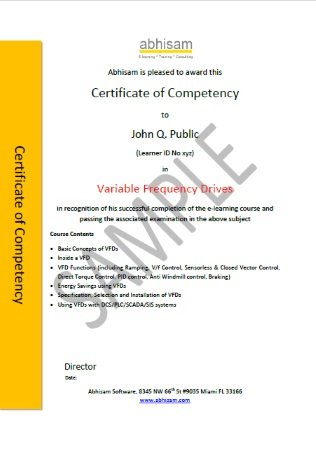
Simply take the Abhisam online exam within the validity of the license period. On passing you get an Electronic Certificate (pdf) as well as a Badge that you can display online on places such as LinkedIn or Facebook.
Which VFD drive brands are covered?
This is a vendor neutral training course. So whether you have an Allen Bradley VFD or one from ABB, or a Powerflex 525 or a Danfoss VFD, everything in this course is applicable.
What is the ordering process?
When you click on the Buy Now button, you will be taken to the Fast Spring secured payment site. Ordering is completely secure. You can pay online by either Credit Card or wire transfer/manual order. Note that you will get the license key to activate only after payment is approved.
What support is available?
You can always email our support team at support[at]abhisam.com if you need anything.
Still Have Questions?
No Problem. Contact Us by filling the form below and we will get back to you.
Choose from any of the versions.
Scroll below to see complete contents.
Standard
For one learner-
Course Duration: 10 hours of self paced learning (Earn 10 PDH)
-
Access the course online 24/7 via any device for one year
-
Exam & Certification for one learner
-
Lifelong Valid Certificate
Professional
For one learner-
Everything in Standard plus
-
Access the course for 3 years
Get Trial Access to all Abhisam courses, including this AC Variable Frequency Drives course for $7. You will NOT be billed automatically after trial ends.
Related Information
Which is the Best VFD Course out there which is affordable, teaches you everything that you need to know, is vendor-neutral, can be accessed from anywhere and gets you a certificate, as well as an electronic badge?
Questions?
Contact Us by filling the form below OR call us OR email