
Plant Decommissioning- How to decontaminate, dismantle and decommission process plants
Free White Paper from Abhisam

Executive Summary
The current economic and socio-political environment has made product lifecycles of chemicals much shorter. Also cost pressures, regulatory pressures, influence of non-state actors and changing market geographies, mean that manufacturing plants (examples are chemical process plants, Oil & Gas facilities, hydrocarbon processing plants and similar) need to be shuffled around, shut down or shifted at a much higher frequency than in earlier years.
This Abhisam white paper is a primer on how company managements can handle this without getting overwhelmed by the complexities of these projects. This can happen because quite a few company managements may be very skilled and versatile when setting up new plants, but may be inexperienced while doing the reverse.
Why decommission?
There has been a change in the economic environment in the world due to various factors such as technological advancement in communications, transport and policies of states such as low entry tariffs, encouragement for foreign direct investment, tax incentives, etc. The product life cycle undergoes a change when an external environment changes. If we look at events in the last few years, it becomes clear that the economic boom and bust cycle happens much faster, unlike in the past, where plants could adjust to the environment over a period of a decade or so. In the present economic climate, there are several times when plants need to be decommissioned. It could be because of technological obsolescence, or due to various regulatory, taxation or cost pressures, or even due to pressures from third parties. Such a situation may also arise due to a buy-out, or due to change in the market geography. In all these cases, there is a need to decommission an existing plant. The fixed assets need to be utilized for alternate products or simply disposed off to recover part of the investment. Alternatively, they can be relocated to a new place, to set up a new facility, which may be geographically, even several thousands of miles away. Typical examples would be of a plant that may be sold off in the US to a Chinese company and the new owner may want to shift it from North America to China. Or an Indian entrepreneur may want to shift a plant from a congested urban location, to a new industrial area in another state. While we have always heard of these cases, the fact is that the frequency of these events happening has increased and will continue to increase as the economy becomes more and more fast-changing and globally integrated.
The common thread amongst all these cases is that a plant (or plants) is to be decommissioned.
Decommissioning a plant in the chemical, pharmaceutical, hydrocarbon processing and similar industries is much more challenging, than other in sectors like engineering or automobile, because of the nature of the chemicals handled in such plants. Many of these may be explosive, toxic or in other ways harmful to the environment. In these plants, where chemicals are toxic, explosive, or corrosive, a sound methodology is needed. This article presents such a methodology.
Where do we start?
Once it is clear that there is a need to decommission the plant, the first stage is estimation of costs. Be aware that many of the garden variety of consultants, contractors and others are very familiar with erection and commissioning costs, but may not be completely at ease with estimating decommissioning costs. So think about getting some help from people who either specialize in these activities, or have a couple of such completed jobs under their belt, to get the best results.
Secondly, ensure that the people whose assistance is solicited are reliable and trustworthy, as the nature of the initial work is confidential. You do not want to unnecessarily alarm your regular employees, or suppliers and other stakeholders. You have to of course involve these people, but at a later date.
Thirdly, many times these shutdown/exit costs are needed not only for actually carrying out the work itself, but also to work out “What-If” and similar strategic scenarios. If your global strategy is therefore going to be based on this figure, then you should be sure that it is a good enough estimate and it is kept under wraps. This cost will be one of the major decision points on whether de-commissioning makes sense or not. This first cost estimate will be the lynchpin on which the whole case (maintaining the status quo, or shutting down the plant) will rest and one cannot stress the importance of arriving at a realistic figure.
The Process-Rolling up your sleeves and starting it
Once it is clear that the plant has to be shut down, one can then start planning the process of doing so. The process of decommissioning is a 3D process- It involves the three Ds of Decontamination, Dismantling and Disposal.
Decontamination
This can be defined as removal of contaminants from the system by washing, heating, chemical treatment and mechanical cleaning. The term contaminant denotes the undesirable chemical entity present in the assets used for manufacture. The internal and external surfaces of equipment are exposed to chemicals during service. Thus the objectives of any decontamination process are
a) To reduce occupational exposure.
b) To salvage the facility, equipment and materials as far as possible.
c) To restore the site for future use which may be an alternate use (e.g. may be commercial rather than industrial).
The forms of contaminants are
a) Solids: Residues, products
b) Liquids: Residual liquids in reactors, tanks, heat exchangers, pumps
c) Vapors: Volatile chemicals in pipes, storage tanks
d) Aerosols: Liquid and solid particles suspended in air. This includes powders and dusts.
Decontamination methods used to clean up the contaminants are
a) Standard: Water, Compressed Air
b) Non-standard: Steam, Caustic, Detergents, etc
The process of decontamination can take place naturally, if a chemically contaminated surface is exposed in air and allowed to be washed with water for a long period of time. The process has no control on time element and the decontamination results cannot be predicted on time line.
The second method uses chemical treatment, water treatment, steam treatment and the decontamination results can be predicted with reasonable accuracy.
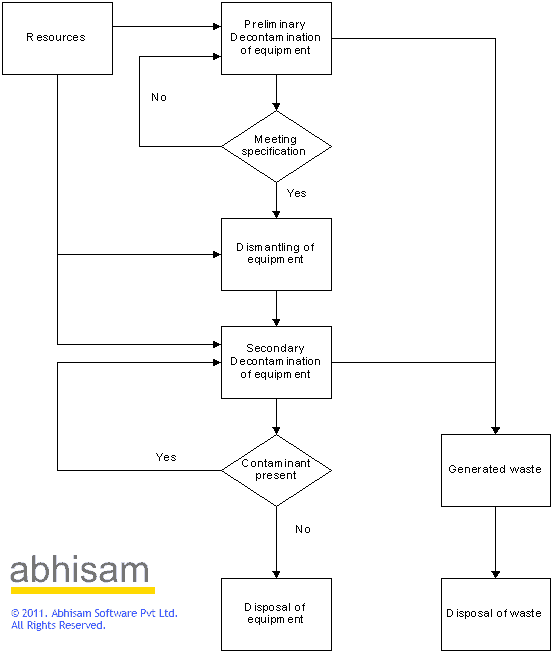
The process flow diagram for the complete process is given below for better understanding.
Decontaminate in Stages
A structured decontamination process is always carried out in multiple stages. Each stage results in the equipment progressively nearing the “clean” status.
These stages are:
a) Primary decontamination: This is the initial cleaning of equipment using chemicals and with water followed by steam/nitrogen/compressed air. The level of contamination is measured. If the contamination level is high, the next activity does not take place unless acceptable decontamination criterion is achieved.
b) Dismantling: The equipment is dismantled to check the presence of contaminant. The stage is also utilized to carry out inspection and testing of equipment to ascertain the utility of equipment for future use
c) Secondary decontamination: The dismantled parts of the equipment are cleaned with chemicals, water, steam and/or compressed air. The level of contaminant is measured at this stage. If the level of contaminant is high, the process is repeated again and again, till acceptable decontamination criterion is achieved.
d) Disposal of equipment: The equipment is declared fit for disposal. It can be sold off or put to use for other purpose (say transported to another location to set up the same plant again).
e) Disposal of waste: The process of decontamination generates liquid and solid waste. This is to be disposed off in a systematic manner. The liquid effluents go to the effluent treatment plant and the solid waste is sent for incineration or any other approved disposal method.
Note: Before you start an end of lifecycle decommissioning project, you will need to carry out a HAZOP Study. Our HAZOP Professional Course, shown below has everything you need to know about Hazard and Operability Study.
Our HAZOP Professional Course, shown below has everything you need to know about Hazard and Operability Study. Before you start an end of lifecycle decommissioning project, you will need to carry out a HAZOP Study. Learn how to carry out HAZOP.
Dismantling
The process of dismantling a chemical plant, oil & gas facility or a pharma plant, starts with selection of a proper contractor (who has experience in dismantling plants in stages) for the facility and infrastructure. The contractor should have requisite number of staff & supervisors to check the quality of work. Many times, the dismantling work would be need to be done in stages, as after the first stage of dismantling, the equipment may need to be given for secondary decontamination. After this is over, it may be dismantled further into its component parts.
The contractor should have sufficient engineering expertise to carry out surveys, make as built drawings, track the dismantled parts and carry out associated jobs, so that nothing gets lost or misplaced, especially if the same plant is to be assembled again at another location.
The dismantled equipment has to be secured with special protective packing e.g. a reactor with stirrer can be transported provided the stirrer is locked. A separate packing arrangement is needed for different types of equipment.
Disposal
The disposal process may consist of either complete disposal of the dismantled plant, or complete shifting of the dismantled plant to another location, or a partial disposal of old equipment (the rest can be salvaged for use in the new plant being assembled at the second location). So there are several variations possible in the break up of equipment that is to be disposed off outright versus the equipment that is to be re-used.
Disposal of effluent and waste should be carried out only after ensuring that a valid consent from the environmental authorities is available and the characteristics of effluent and waste are well within the norms specified in the consent order.
Risk Assessment
The processes involved in decontamination, dismantling and disposal are not routine processes and considerable deviations take place in carrying out the last batches in equipment and the cleaning operations that follow. A thorough risk assessment study is needed for each of the procedures. It is recommended that such exercise be planned well in advance to mitigate the effects of the activities on safety of people and environment.[/sociallocker]
In case this is not done properly, some unfortunate incidents may occur, for which normally company managements are held liable for prosecution, by the authorities. Hazard and Operational Study is an excellent risk assessment tool that can be used in any stage of a plant’s lifecycle, including decommissioning. To know more about it, please download or access online our e-learning course.
Internal support from various departments
The decommissioning project should involve members from other departments too, whose expertise would be necessary in carrying out the project. These are people from Finance & Accounting, Taxation, Purchasing, IT and HR who would be helping the core team from Production/Plant Operations, Engineering/Maintenance & Safety / Environmental services, to complete the project. Involving the corporate audit team is also recommended since a lot of asset disposal, asset modifications, scrap sales and so on are involved. The site administration team is also important since these people will be getting the necessary permissions from regulatory authorities, tax authorities and local communities who may be adversely affected by the shifting.
Conclusion
As can be seen from above, the decommissioning process for a manufacturing plant or a site is complex in nature; it is not a simple “demolish and exit” job. Hence, a structured approach is essential for success. However, each decommissioning may have certain unique features that require special procedures to be developed. It is a good idea to get help from experts (who have plant decommissioning expertise) wherever necessary. The project can be as complex (or even more so), as compared to setting up a new plant or facility.
Need help with Decontamination, Decommissioning or related stuff?
Abhisam’s Subject matter experts on Decontamination, Decommissioning and Disposal can help you understand the process, help you with estimation of costs, guide you in creating your own project management plan and lead it too! Abhisam’s experts have more than a hundred man years expertise between them, in process plants of all sizes and have extensively worked in Decontamination, Decommissioning, Dismantling, Disposal and/or plant relocation services, taking all environmental standards, rules and regulations into account. Get in touch with us today for help! We are there for you.
More White papers.
Watch this space.
Contact Us by filling the form below OR call us OR email
